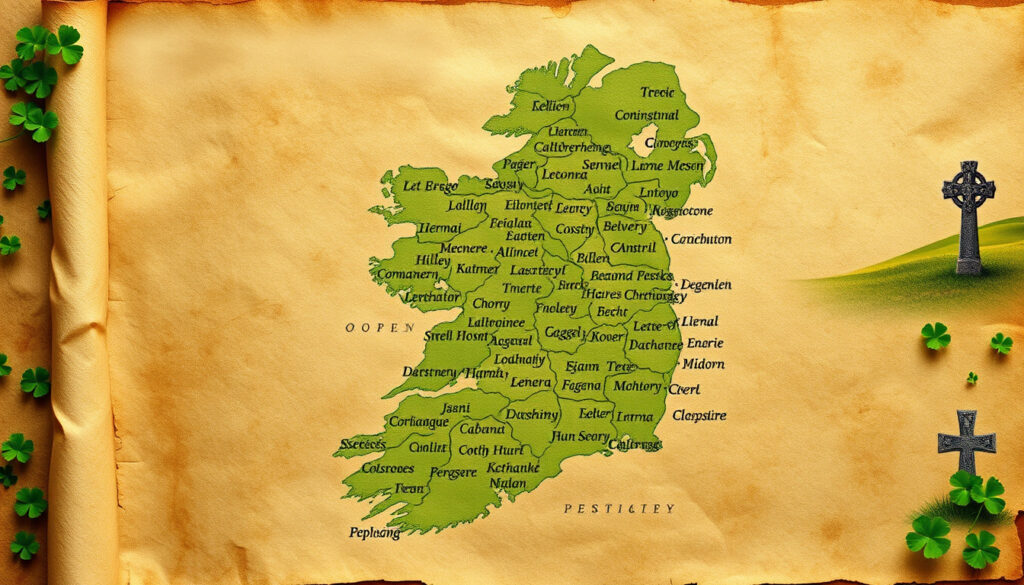
Counties of Ireland in Irish – All 32 Names, Pronunciations & Meanings
Ireland’s 32 traditional counties carry names rooted in centuries of history, each Irish Gaelic version telling its own story of kingdoms, landscapes, and people. From the rolling hills of Laighin (Leinster) to the rugged coastline of Ulaidh (Ulster), these county names preserve a linguistic heritage that dates back to the Norman era and beyond. This guide presents every county name in Irish, along with pronunciations, meanings, and provincial groupings.
The Irish language, or Gaeilge, uses the term Contae for a county (plural: Contaetha), a designation that became standard during the Norman administrative reorganization of Ireland in the 12th century. While English names dominate everyday usage, Irish Gaelic forms remain official in the Republic of Ireland and serve as markers of cultural identity across the island.
Understanding these names offers insight into Ireland’s geography, mythology, and layered history—where Norse merchants, Gaelic chieftains, and Norman lords all left their linguistic fingerprints on the land.
What Are the Counties of Ireland Called in Irish?
The 32 counties of Ireland are divided into four provinces: Ulster, Leinster, Connacht, and Munster. Each province contains its own distinct grouping of counties, with Irish names that reflect ancient boundaries, natural features, and historical connections.
- Irish names are official in the Republic and are standardized by the Placenames Commission
- Northern Ireland counties ceased using Irish names for local government in 1973
- Some counties share identical or similar names across different provinces
- Irish names preserved most strongly in Gaeltacht (Irish-speaking) areas
- Pronunciations vary between regional dialects (Ulster Irish differs from Munster Irish)
- Norse-origin names like Waterford (Port Láirge), Wexford (Loch Garman), and Wicklow (Cill Mhantáin) reflect Viking influence
- The province of Ulster spans both Northern Ireland and the Republic of Ireland
Complete Table: All 32 Counties in Irish with Pronunciations
| English Name | Irish Gaelic Name | Pronunciation | Meaning | Province |
|---|---|---|---|---|
| Antrim | Aontroim | AWN-trim | “Lone ridge” | Ulster (NI) |
| Armagh | Ard Mhacha | Ard WAH-kha | “Height of Macha” | Ulster (NI) |
| Cavan | An Cabhán | un kah-VAWN | “The hollow” | Ulster (ROI) |
| Clare | An Chláir | un CLAWR | “The plain” | Munster (ROI) |
| Cork | Corcaigh | KOR-kee | “Marshy place” | Munster (ROI) |
| Donegal | Dún na nGall | DOON nuh nGALL | “Fort of the foreigners” | Ulster (ROI) |
| Down | An Dún | un DOON | “The fort” | Ulster (NI) |
| Dublin | Baile Átha Cliath | BLAH-cliff | “Town of the ford of hurdles” | Leinster (ROI) |
| Fermanagh | Fear Manach | FER ma-nakh | “Men of Monach” | Ulster (NI) |
| Galway | Gaillimh | GAH-liv | “Stony” | Connacht (ROI) |
| Kerry | Ciarraí | KEER-ee | “People of Ciar” | Munster (ROI) |
| Kildare | Cill Dara | kill DAH-ra | “Church of the oak” | Leinster (ROI) |
| Kilkenny | Cill Chainnigh | kill KAH-nig | “Church of Cainnech” | Leinster (ROI) |
| Laois | Laois | LEESH | “People of Lugaid Laigne” | Leinster (ROI) |
| Leitrim | Liatroim | LEE-tra-trim | “Gray ridge” | Connacht (ROI) |
| Limerick | Luimneach | LWIH-nakh | “Bare spot” or “mud island” | Munster (ROI) |
| Londonderry/Derry | Doire | DER-ee | “Oak grove” | Ulster (NI) |
| Longford | An Longfort | un LUNG-fort | “Long fort” | Leinster (ROI) |
| Louth | Lú | LOO | “Small” or mythical figure | Leinster (ROI) |
| Mayo | Maigh Eo | MHIGH yo | “Plain of the yew trees” | Connacht (ROI) |
| Meath | An Mhí | un VEE | “The middle” | Leinster (ROI) |
| Monaghan | Muineachán | MWIH-nakh-awn | “Thickety place” | Ulster (ROI) |
| Offaly | Uíbh Fhailí | EE-vawl-ee | “Descendants of Fail” | Leinster (ROI) |
| Roscommon | Ros Comáin | ross ko-MAHN | “Wood of Comán” | Connacht (ROI) |
| Sligo | Sligeach | SLIG-akh | “Shelly river” | Connacht (ROI) |
| Tipperary | Tiobraid Árann | TIRP-rit aw-RUN | “Well of Ara” | Munster (ROI) |
| Tyrone | Tír Eoghain | TEER YO-in | “Land of Eoghan” | Ulster (NI) |
| Waterford | Port Láirge | Port LAWR-ghe | Norse: “inlet” | Munster (ROI) |
| Westmeath | An Iarmhí | un IR-vee | “West of Meath” | Leinster (ROI) |
| Wexford | Loch Garman | Lokh GAR-man | Norse: “fjord of mudflats” | Leinster (ROI) |
| Wicklow | Cill Mhantáin | Kill man-TAWN | “Church of Mantán” | Leinster (ROI) |
The Placenames Database (Logainm.ie) maintained by the Irish Department of Tourism, Culture, Arts, Gaeltacht, Sport and Media provides the authoritative Irish-language forms for all place names in the Republic of Ireland.
Irish Names for the 26 Counties of the Republic of Ireland
The Republic of Ireland encompasses 26 counties spread across three provinces: Leinster (12 counties), Munster (6 counties), and Connacht (5 counties), plus three counties of Ulster (Cavan, Donegal, and Monaghan).
Counties of Leinster in Irish
Leinster, the easternmost province, contains the largest concentration of counties. Dublin, the national capital, is known in Irish as Baile Átha Cliath (“town of the ford of hurdles”). The province’s name Laighin likely derives from a pre-Christian tribal designation.
Notable county names include Kildare (Cill Dara, “church of the oak”), Meath (An Mhí, “the middle”—once the kingdom of Mide), and Offaly (Uíbh Fhailí, “descendants of Fail”). Laois (Laois) and Offaly were formerly known as Queen’s County and King’s County respectively during English colonial rule.
Counties of Munster in Irish
Munster, the southern province, takes its Irish name An Mhumhan from the goddess Muma. Cork (Corcaigh), the largest county by area, means “marshy place,” while Clare (An Chláir) refers to “the plain.”
Kerry (Ciarraí, “people of Ciar”) preserves the name of an ancient kingdom, and Tipperary (Tiobraid Árann, “well of Ara”) derives from a local saint or chieftain. Limerick (Luimneach) carries meanings ranging from “bare spot” to “mud island,” while Waterford (Port Láirge) reflects its Norse origins as a Viking settlement.
Counties of Connacht in Irish
Connacht (Connachta) in the west contains five counties, with Galway (Gaillimh, “stony”) being the most prominent. The name refers to the Gaillimh river, now known as the Corrib.
Mayo (Maigh Eo, “plain of the yew trees”), Sligo (Sligeach, “shelly river”), Leitrim (Liatroim, “gray ridge”), and Roscommon (Ros Comáin, “wood of Comán”) complete the Connacht counties, each name rooted in local geography or historical figures.
Regional dialects affect how Irish county names are pronounced. Ulster Irish tends toward harder consonants, while Munster Irish features softer, more nasal sounds. The pronunciations provided here are simplified phonetic approximations.
The 6 Counties of Northern Ireland in Irish Gaelic
Northern Ireland comprises six counties, all within the province of Ulster. While Irish Gaelic names remain culturally significant, they ceased official use for local government administration following the 1973 reorganization that replaced traditional counties with 26 district councils.
Ulster Counties Under British Administration
Antrim (Aontroim, “lone ridge”), Down (An Dún, “the fort”), and Armagh (Ard Mhacha, “height of Macha”) form the core of the region. Armagh’s name honors the war goddess Macha, while its city remains a significant ecclesiastical center.
Londonderry, commonly called Derry (Doire, “oak grove”), Fermanagh (Fear Manach, “men of Monach”), and Tyrone (Tír Eoghain, “land of Eoghan”) complete the six counties. These names continue to appear on signage in Gaeltacht areas and feature in Irish-language media and education.
The Irish names for these counties persist in cultural contexts, sporting competitions governed by the Gaelic Athletic Association, and among Irish language speakers regardless of political boundaries. The Irish government’s placenames department maintains records of these traditional designations.
How Many Counties Are There in Ireland?
Ireland contains 32 traditional counties, a number that has remained consistent since the Norman administrative system became established in the 12th century. These divisions originated as Norman shires, though many Irish Gaelic names predate Norman rule and reflect earlier territorial boundaries.
Distribution by Jurisdiction
- Republic of Ireland: 26 counties
- Northern Ireland: 6 counties
- Total: 32 traditional counties
Distribution by Province
- Ulster: 9 counties (6 in Northern Ireland, 3 in Republic)
- Leinster: 12 counties (all in Republic)
- Munster: 6 counties (all in Republic)
- Connacht: 5 counties (all in Republic)
While 32 traditional counties remain culturally significant, modern local government differs. The Republic of Ireland now operates with 26 county councils and various city councils, with some former counties subdivided (e.g., Dublin divided into four local authority areas). Northern Ireland has operated under district council arrangements since 1973.
Provinces themselves hold no modern legal status but remain important for sporting purposes, cultural identity, and genealogical research. The Gaelic Athletic Association organizes competitions along provincial lines, preserving these ancient divisions for contemporary Ireland. For those interested in the visual representation of these divisions, here is how to draw a beginners guide. how to draw a beginners guide
Historical Development of Irish Counties
The county system took shape following the Norman invasion of 1172, when English administrators organized conquered territories into shires modeled on English practice. However, many Gaelic kingdoms and túath territories predate these divisions by centuries.
- 12th century: Norman administration establishes counties throughout Ireland
- 13th–15th centuries: County boundaries gradually formalized and expanded
- 1540s: Tudor conquest leads to new county formations (e.g., County Laois established 1556)
- 1565: Connacht counties of Clare, Galway, and Leitrim formally created
- 1921: Partition divides Ulster, with 6 counties becoming Northern Ireland
- 1922: Irish Free State established with 26 counties
- 1973: Northern Ireland reorganizes into districts, ending county council administration
The partition of Ireland in 1921 created the six counties of Northern Ireland within the United Kingdom, while the remaining 26 counties formed the Irish Free State (later Republic of Ireland). Despite this political division, traditional county identities remain strong on both sides of the border.
What Is Certain and What Remains Unclear?
Well-Established Facts
- 32 traditional counties recognized across the island
- Four provinces with consistent memberships
- Irish names for all 32 counties documented and standardized
- Counties established during Norman period, formalized by 16th century
- Irish names official in Republic; cultural significance in Northern Ireland
- Norse influence visible in coastal county names
Areas of Uncertainty
- Exact origins of some county name meanings debated among linguists
- Pronunciation guides represent simplified approximations
- Some Northern Ireland boundary adjustments post-1973 remain unclear
- Precise original tribal boundaries of pre-Norman territories disputed
- Regional dialect variations in Irish pronunciation not fully documented
Why County Names in Irish Matter
The preservation and use of Irish Gaelic county names reflects broader efforts to maintain linguistic heritage in an English-dominated environment. Irish-language education, media, and official signage in Gaeltacht areas ensure these names remain in active use.
For those seeking to learn Irish or connect with Irish heritage, understanding county names provides entry into Gaelic grammar, pronunciation patterns, and cultural history. The county system on Wikipedia offers additional historical context for these designations.
Researchers and genealogists find Irish county names essential for understanding historical records, as documents predating English standardization often used only the Gaelic forms. IrishCentral’s guide to county name origins provides additional context for how these designations evolved over centuries.
The Irish names for counties preserve connections to ancient kingdoms, landscape features, mythological figures, and historical families—each name a window into Ireland’s layered past.
Summary
Ireland’s 32 counties carry Irish Gaelic names that encode centuries of history, geography, and cultural identity. From Baile Átha Cliath (Dublin) to Tír Eoghain (Tyrone), these names connect modern Ireland to its Gaelic and Norman past. Whether for language learning, genealogical research, or simply understanding Irish heritage, familiarity with these Irish names enriches appreciation of Ireland’s enduring linguistic landscape.
Those interested in practical information about living or traveling in Ireland may find the Gas and Electricity Ireland – Cheapest Providers and Prices 2025 guide useful for understanding regional utilities and costs.
Frequently Asked Questions
What are the four provinces of Ireland called in Irish?
The four provinces are Ulaidh (Ulster), Laighin (Leinster), Connachta (Connacht), and An Mhumhan (Munster).
How many counties does Ireland have?
Ireland has 32 traditional counties: 26 in the Republic of Ireland and 6 in Northern Ireland.
What does Contae mean?
Contae is the Irish word for “county” (plural: Contaetha), derived from medieval Norman administrative terminology.
Why do some Irish county names have Norse origins?
Viking settlements along the coast, particularly in the 9th–11th centuries, influenced place names in Waterford, Wexford, Wicklow, and other coastal areas.
Are Irish county names official in Northern Ireland?
Irish names ceased official administrative use in Northern Ireland after 1973, though they remain culturally significant and appear in Gaeltacht areas.
Where can I find authoritative Irish county names?
The Placenames Database (Logainm.ie) maintained by the Irish government provides official Irish-language forms for all placenames.
Which province contains the most counties?
Leinster contains the most counties with 12, followed by Ulster with 9 (though only 3 in the Republic), Munster with 6, and Connacht with 5.
More related posts
 Kids Science Experiments at Home – Easy Household Activities
 Irish Army Ranger Wing: Roles, Training, Selection
 Internet Cafe Near Me: Find Open Internet Cafes in Dublin & Galway
 Live Horse Racing Today – Schedules, TV & Results
 Sheen Falls Lodge Kenmare: Ownership, Rooms & Spa
 Teen Jockey Upsets Mullins: Jamie Martin’s Dream Debut
 Crystal Palace vs Sunderland: Results, H2H & Live Coverage
 What Is the Best Post Workout Food? Top Recovery Picks
