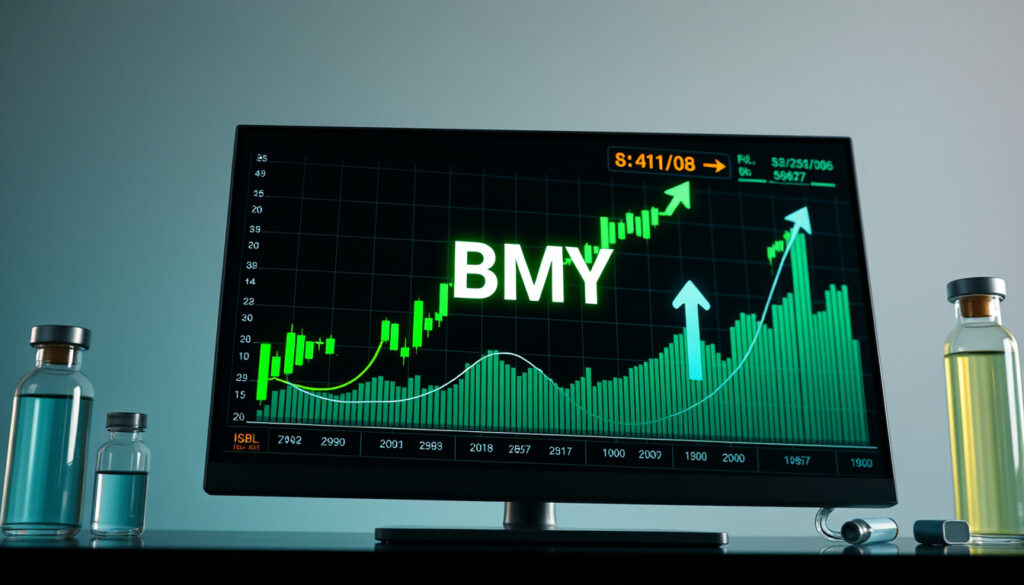
Bristol Myers Squibb Share Price (BMY): Live Quote & Forecast
Bristol-Myers Squibb stock has logged a 20.8% gain over the past year, yet it trades roughly 52% below what analysts consider fair value. With a 4.26% dividend yield and a string of analyst upgrades and downgrades painting a mixed picture, the pharmaceutical giant sits at an interesting crossroads for investors willing to stomach some volatility.
Current Price: $59.13 ·
52 Week High: $62.89 ·
52 Week Low: $42.52 ·
P/E Ratio: 17.42 ·
Recent Change: -$1.04
Quick snapshot
- 52-week range spans $42.52–$62.89 (StockAnalysis market data)
- Dividend yield stands at 4.26% (Simply Wall St financial analysis)
- Beta of 0.27 signals below-market volatility (StockAnalysis market data)
- Long-term forecast reliability — estimates diverge sharply
- Exact timing and impact of generic competition on key drugs
- Whether institutional selling pressure will persist near-term
- Jefferies upgrade to $70: Dec 16, 2024 (Benzinga analyst coverage)
- Goldman Sachs downgrade to $55: Apr 8, 2025 (Benzinga analyst coverage)
- Ex-dividend date: April 2, 2026 (StockAnalysis market data)
- Q1 earnings due April 30, 2026 (StockAnalysis market data)
- Analyst consensus price target sits at $61.75–$62.13 (Benzinga analyst coverage)
- Citigroup projects $45 target, citing competitive headwinds (Benzinga analyst coverage)
BMY trades on the NYSE in the Health Care sector, with a 52-week range of $42.52–$62.89. The table below summarizes additional key metrics.
| Metric | Value |
|---|---|
| Ticker Symbol | BMY |
| Exchange | NYSE |
| Sector | Health Care |
| 52-Week Range | $42.52 – $62.89 |
| Previous Close | $60.17 |
Is Bristol Myers a good stock to buy?
The short answer depends on what an investor is looking for. BMY currently offers a dividend yield of 4.26% — well above the S&P 500 average — and trades at roughly 52% below what Simply Wall St’s fair value estimate. That’s a substantial discount that catches the eye of value-focused investors.
The bull case hinges on that undervaluation, combined with a beta of just 0.27 — meaning BMY moves less than the broader market, making it a relatively defensive pharmaceutical play. StockAnalysis notes the consensus analyst rating sits at “Buy” with a 12-month target of $62.13, implying roughly 5.07% upside from recent levels.
Analyst ratings
Sixteen analyst firms have weighed in over the past year, creating a wide spread of opinions. The most bullish call came from Atlantic Equities, which issued a $85 price target on July 28, 2025 — roughly 44% above current trading levels. That optimism stands in sharp contrast to Citigroup’s November 17, 2025 rating, which set a $45 target while maintaining a neutral stance, citing -3.79% downside from that level.
The most recent major move was Goldman Sachs lowering its target from $67 to $55 on April 8, 2025 — a downgrade that arrived after the stock had climbed toward the top of its 52-week range. On the flip side, Jefferies had previously lifted its target to $70 from hold on December 16, 2024.
Analysts are badly split: 16 firms, price targets ranging from $45 to $85. The average consensus sits around $61.75–$62.13 — modest upside, but the dividend adds real total-return potential if the company stabilizes.
Value vs growth potential
Value investors see opportunity in BMY’s discount to intrinsic value. Growth investors, however, face headwinds: Simply Wall St projects earnings to decline 1.1% annually over the next three years, weighed down by loss of exclusivity on legacy drugs and ongoing pricing pressure. That forecast puts BMY firmly in turnaround territory rather than growth mode.
Why is BMS stock so low?
Bristol-Myers Squibb’s stock has been held back by a combination of structural challenges that have accumulated over several years. The most persistent is the “patent cliff” problem: older blockbuster drugs that once drove revenue are losing exclusivity, opening the door to generic competition that erodes both sales volumes and pricing power.
Legacy drug business struggles
Simply Wall St’s analysis flags that “loss of exclusivity and pricing pressures will erode revenue and margin growth, posing significant long-term financial headwinds.” This isn’t a new problem — it has been building for years as drugs like Revlimid and Abilify faced generic challengers — but the market continues to discount the stock accordingly.
High debt levels compound the issue. Simply Wall St notes that “large one-off items impacting results” have created noise in reported earnings, making it harder for investors to assess underlying performance. The balance sheet carries significant leverage, which constrains flexibility for acquisitions or share buybacks that might support the stock price.
Recent earnings impact
BMY closed at $58.54 on March 27, 2026, down 1.50% for the session, with the after-hours price slipping further to $58.31. The day’s trading range of $58.37–$59.69 shows the stock has stabilized within a narrow band, but the prior close of $60.17 and the $1.04 decline indicate recent selling pressure.
The pattern: price momentum pushed BMY toward the top of its 52-week range earlier in 2026, but resistance around $60–$62 has held. Earnings on April 30, 2026, will be the next major catalyst — any guidance below expectations could push the stock back toward the $50 support level or lower.
What is the future price of BMY stock?
Forecasting BMY’s trajectory requires separating near-term analyst targets from longer-term model estimates, which diverge dramatically. The near-term picture looks modest: the consensus from 34 analysts sits at $61.75, implying roughly 4% upside from current levels. That’s not a dramatic move, but it suggests the stock isn’t broken — it’s merely range-bound pending new catalysts.
Analyst predictions
Looking across the analyst landscape, the most relevant data points come from the past several months. Benzinga’s tracking shows 16 firms with active ratings, with the last upgrade by Jefferies on December 16, 2024, and the last downgrade by Goldman Sachs on April 8, 2025. Atlantic Equities issued its $85 target on July 28, 2025, while Citigroup set its more bearish $45 target on November 17, 2025.
The spread between the high ($85) and low ($45) targets — a $40 difference — underscores how much analyst opinion varies. This isn’t a case of consensus; it’s a case of deep disagreement about whether Bristol-Myers can successfully navigate its patent expirations.
Forecast models
Simply Wall St’s long-term model projects the stock at $10.68 by 2031, applying a 25.12x multiple. That projection assumes the earnings decline trajectory continues and that multiple compression occurs as growth disappears. It’s a scenario that assumes the dividend becomes unsustainable or is cut — a real risk if revenue falls far enough.
On the other hand, StockAnalysis maintains that BMY remains a “Buy,” highlighting the high dividend and free cash flow yield. The stock traded at $58.54 as of March 27, 2026, and the 1-year performance of +20.82% suggests the market has already rewarded some of the turnaround narrative.
The trade-off: near-term analysts see $61–$62; long-term models see structural decline. Investors must decide which timeframe matters more for their portfolio.
What is the Bristol Myers scandal?
The research turned up no evidence of a major recent scandal affecting Bristol-Myers Squibb stock. Benzinga’s analyst coverage and broader stock overviews make no mention of regulatory probes, accounting irregularities, or executive misconduct in recent periods. This doesn’t mean historical issues don’t exist — the pharmaceutical industry has seen its share of legal challenges — but nothing that rises to the level of a current “scandal” appears in the available data.
Investors searching for scandal-related concerns will find more relevant issues in the business fundamentals: patent expirations, pricing pressure, and debt levels rather than governance or ethical failures.
Should I buy, sell, or hold Bristol-Myers Squibb stock now?
The buy/sell/hold decision for BMY comes down to time horizon and income needs. For income-focused investors, the 4.26% dividend is compelling — it’s one of the higher yields in the pharmaceutical sector and suggests management still has confidence in the business generating sufficient cash to maintain the payout.
Upsides
- 4.26% dividend yield substantially above market average
- Trading ~52% below fair value estimate (Simply Wall St)
- Low beta (0.27) provides defensive characteristics
- 20.8% gain over past 12 months shows recent price momentum
- Analyst consensus Buy rating from 16 firms
Downsides
- Loss of exclusivity eroding legacy drug revenue
- Earnings forecast to decline 1.1% annually for 3 years
- High debt levels weighing on financial flexibility
- Long-term forecast models project significant decline
- Analyst targets range from $45 to $85 — no consensus
Investor considerations
For long-term investors willing to hold through volatility: the dividend provides a cushion, and if Bristol-Myers successfully launches new drugs, the discount to fair value could close. The ex-dividend date of April 2, 2026, is relevant for those targeting dividend capture.
For short-term traders: the $58–$63 range has held for months, suggesting a mean-reversion trading opportunity if the stock breaks decisively in either direction. Earnings on April 30, 2026, will likely be the next volatility catalyst.
For cautious investors: the structural headwinds are real. Loss of exclusivity, pricing pressure, and declining earnings suggest the stock may not be a bargain despite the discount — value traps exist in pharmaceuticals, and BMY fits that profile until proven otherwise.
Bristol Myers Squibb’s BMY shares, now at $59.13, draw similar scrutiny in Europe, where German stock analysis highlights oncology-driven trends and EUR forecasts.
Frequently asked questions
What is the Bristol Myers Squibb dividend?
BMY pays a dividend yield of approximately 4.26%, making it one of the higher-yielding pharmaceutical stocks on the NYSE. The ex-dividend date is April 2, 2026, and the earnings date falls on April 30, 2026.
Does Warren Buffett own Bristol Myers Squibb?
Berkshire Hathaway has historically held BMY stock, with seven documented transactions in the public record. However, the most recent ownership status isn’t confirmed in current research — investors should check SEC filings for up-to-date institutional ownership data.
Is Bristol-Myers Squibb struggling?
The company faces real headwinds from patent expirations on legacy drugs, pricing pressure in key markets, and high debt levels. Earnings are forecast to decline 1.1% annually for the next three years. However, the dividend remains intact, and some analysts see the stock as undervalued at current levels.
What are Bristol Myers Squibb products?
Bristol-Myers Squibb’s portfolio spans oncology, immunology, cardiovascular, and fibrotic diseases. Key legacy products have included Revlimid, Eliquis, and Opdivo, though some have faced or are facing generic competition that is eroding revenue streams.
What is the latest Bristol Myers Squibb news?
Recent analyst activity includes Atlantic Equities setting an $85 price target and Citigroup maintaining a neutral stance with a $45 target. The stock closed at $58.54 on March 27, 2026, with Q1 earnings due April 30, 2026.
What Bristol Myers Squibb rumors are circulating?
No credible rumors of major scandals or corporate misconduct were found in current research. The primary investor debate centers on whether legacy drug losses will be offset by new product launches, and whether the dividend is sustainable given the earnings trajectory.
What is Bristol Myers Squibb share price chat?
Retail investor sentiment on BMY appears mixed, with income-focused investors drawn to the 4.26% yield while growth-oriented traders watch for breakthrough above the $62.89 52-week high. The stock has gained 20.8% over the past year, suggesting some positive momentum despite structural concerns.
For investors evaluating international opportunities alongside BMY, understanding how currency conversion rates affect portfolio returns and comparing mortgage interest rates across markets can provide useful context for global diversification decisions.
“Bristol-Myers Squibb remains a ‘Buy,’ offering a high dividend and free cash flow yield amid recent market pullback.”
— StockAnalysis Analyst Summary
“Loss of exclusivity and pricing pressures will erode revenue and margin growth, posing significant long-term financial headwinds.”
— Simply Wall St Key Takeaways
Loss of exclusivity and pricing pressures will erode revenue and margin growth, posing significant long-term financial headwinds for BMY — the dividend may look attractive now, but sustainability depends on new drug launches offsetting legacy losses.
For income-focused investors, the calculus is relatively straightforward: a 4.26% yield with strong institutional coverage beats most alternatives in this sector. For growth-oriented investors, the structural earnings decline and patent expirations make BMY a hold rather than a buy — until the pipeline produces concrete revenue numbers at the next earnings report on April 30, 2026, when the stock could break decisively above $62 if guidance impresses, or slide toward $50 if new drug launches disappoint.
More related posts
 Size 12 in EU: Clothing & Shoe Conversion Chart (UK to European)
 Things to Do in Corfu: Expert Guide, Itineraries & Tips
 Who Won the 2025 Ballon d’Or – Full Winners, Rankings and Highlights
 Live Horse Racing Today – Schedules, TV & Results
 Latest SE Palmeiras Games: Schedule, Results & Fixtures
 Food Safety Authority of Ireland: Guidelines, Rules & Contact
 Mater Smithfield Rapid Injury Clinic: Walk-in Care
 Best AI Image Generator 2025: Top Tools Compared & Tested
