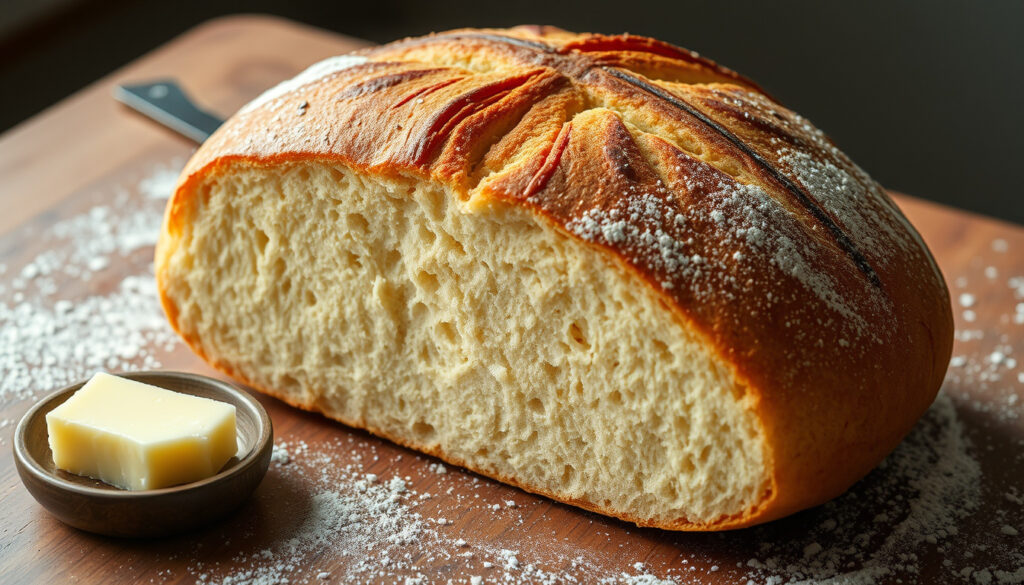
Irish Soda Bread Recipe: Soft, Tender Loaf Every Time
There’s a reason Irish soda bread has been a kitchen staple for generations—it’s simple, quick, and deeply satisfying. In just about an hour, with a handful of everyday ingredients, you can pull a tender, crusty loaf from the oven.
Prep time: 10 minutes ·
Cook time: 45 minutes ·
Skill level: Easy ·
Yield: 1 loaf ·
Key ingredient: Buttermilk and baking soda
Quick snapshot
- Baking soda reacts with acid from buttermilk to produce carbon dioxide (Serious Eats (culinary science authority))
- Traditional Irish soda bread uses no yeast (King Arthur Baking (baking education resource))
- Scoring a cross on top helps the loaf expand evenly (National Geographic (cultural history publication))
- Exact origin of soda bread is uncertain (Encyclopaedia Britannica (reference publisher))
- Whether earliest versions used buttermilk or sour milk is not documented (Encyclopaedia Britannica (reference publisher))
- When the cross-slashed shape became standard is not precisely dated (Encyclopaedia Britannica (reference publisher))
- Commercial baking soda became widely available in the 19th century, enabling the rise of soda bread (National Geographic)
- Master hydration and acidity balance for a soft crumb
- Explore variations with wholemeal flour, oats, or dried fruit
Five key facts about Irish soda bread, from its origins to what makes it unique.
| Fact | Details |
|---|---|
| Origin | Ireland (19th century) |
| Key leavening agent | Baking soda (sodium bicarbonate) |
| Typical flour | Soft wheat flour or wholemeal |
| Average bake time | 40–50 minutes |
| Shelf life | Best eaten within 1–2 days |
| Internal temperature (done) | ~195°F (90°C) (Sally’s Baking Addiction (trusted recipe source)) |
| Typical baking temperature | 375°F (190°C) |
| Key chemical reaction | Baking soda + acid (buttermilk) → CO₂ bubbles |
How to make the perfect Irish soda bread?
Essential ingredients
The core ingredients are few: all-purpose or wholemeal flour, baking soda, salt, and buttermilk. Some recipes add a small amount of butter or sugar for a softer crumb, as noted by King Arthur Baking (baking resource). The buttermilk is not optional—its acidity triggers the leavening reaction (Serious Eats).
Step-by-step mixing instructions
- Preheat oven to 375°F (190°C). Line a baking sheet or grease a cast-iron skillet.
- In a large bowl, whisk together 4 cups (480g) flour, 1 teaspoon baking soda, and 1 teaspoon salt. Sieve the baking soda to remove lumps—this ensures even distribution (Sally’s Baking Addiction).
- Make a well in the center and pour in 1½–2 cups (360–480 ml) buttermilk. Stir with a wooden spoon until just combined—do not overmix. The dough should be soft and slightly sticky, not dry (King Arthur Baking).
- Turn dough onto a lightly floured surface and knead briefly, 5–6 turns, just to bring it together.
- Shape into a round loaf about 7 inches across. Place on prepared pan.
- Use a sharp knife to score a deep cross on top, about ½ inch deep. This helps the loaf expand and allows the center to bake through (National Geographic).
- Bake for 40–45 minutes until golden brown and the bottom sounds hollow when tapped. Internal temperature should reach 195°F (Sally’s Baking Addiction).
The cross is not just tradition—it helps the loaf bake evenly and prevents cracking. Cutting deeply enough matters: a shallow score won’t open properly.
The implication: bakers who score deeply and handle the dough lightly will see a more even rise and a softer center.
Baking and cooling
Cool the loaf on a wire rack for at least 20 minutes before slicing. Soda bread is best eaten warm, but never cut into a hot loaf—the steam will make the crumb gummy (Sally’s Baking Addiction). Wrap leftovers in a cloth and consume within two days; after that, toast it.
The pattern: precise measurement and minimal handling separate a good loaf from a great one.
What is the secret to a soft soda bread?
Hydration balance
A dry dough produces a tough, crumbly loaf. The ideal consistency is soft and slightly tacky—not sticky. Adding too much flour during shaping is the most common culprit (King Arthur Baking). Start with the lower amount of buttermilk and add more only if needed.
Acid content and buttermilk
Buttermilk’s acidity is what reacts with baking soda to create CO₂. Without enough acid, the bread won’t rise properly and will be dense. If you need a substitute, add 1 tablespoon lemon juice or vinegar to regular milk and let it sit for 5 minutes (Serious Eats).
Mixing technique
Overmixing develops gluten, which gives bread structure—but soda bread benefits from a tender, cake-like crumb. Mix just until the dry ingredients are moistened. The fewer stirs, the softer the result (Sally’s Baking Addiction).
Overmixing develops gluten, turning a tender crumb into a tough one. Light handling is the single most important step for a soft loaf.
The catch: those who ignore hydration balance will end up with a dry, crumbly loaf.
What are common soda bread mistakes?
Overmixing the dough
As noted, excessive mixing or kneading creates a dense, rubbery texture. The dough should come together in seconds, not minutes (Sally’s Baking Addiction).
Using wrong flour
Self-rising flour already contains baking powder and salt, which throws off the acid balance. Stick with all-purpose or wholemeal flour plus baking soda (King Arthur Baking).
Skipping the rest time
Allowing the dough to rest for 10–15 minutes before baking helps the gluten relax and the baking soda start reacting. Baking immediately can produce a dense center (Countryside Cravings (home baking blog)).
Incorrect oven temperature
A too-cool oven slows the chemical reaction and results in a flat loaf. Preheat thoroughly and use an oven thermometer if needed—375°F is standard (Sally’s Baking Addiction).
Many bakers skip the rest time, but those 10 minutes make the difference between a fluffy loaf and a hockey puck.
The pattern: each mistake compounds, but correcting them all yields immediate improvement.
What is the best flour for soda bread?
White flour vs wholemeal
Traditional Irish brown soda bread uses a mix: about half wholemeal (or whole-wheat) flour and half white flour. The wholemeal adds nuttiness, the white flour ensures a lighter crumb (BBC Travel (cultural and food journalism)).
Bread flour vs all-purpose
Bread flour has higher protein content, which produces more gluten. For soda bread, lower protein flours (like all-purpose) yield a more tender crumb because gluten development is minimal (King Arthur Baking). All-purpose is the safest choice for beginners.
Specialty flours like spelt
Spelt or ancient-grain flours can replace part of the white flour, adding flavor. They absorb less liquid, so reduce buttermilk by 2–3 tablespoons (Countryside Cravings).
What this means: flour choice is the easiest lever to pull for texture control.
What makes Irish soda bread different from regular bread?
No yeast required
Regular bread relies on yeast fermentation, which takes hours of proofing. Soda bread uses a chemical reaction that works instantly (Encyclopaedia Britannica).
Baking soda as leavening
The reaction between baking soda and an acid (buttermilk) produces carbon dioxide bubbles without fermentation. This eliminates kneading and proofing time (King Arthur Baking).
Quick preparation time
From start to oven: under 15 minutes of active work. No waiting for dough to rise. This made it a practical daily bread for Irish households (BBC Travel).
Dense, moist texture
Without yeast’s long fermentation, soda bread has a denser, more cake-like crumb. It also dries out faster—best eaten day-of or toasted the next morning (Sally’s Baking Addiction).
The pattern: the trade-off between convenience and shelf life is clear, but fresh soda bread is unbeatable.
Confirmed facts vs what’s unclear
Confirmed facts
- Baking soda reacts with acid from buttermilk to produce carbon dioxide (Serious Eats)
- Irish soda bread is a traditional quick bread without yeast (King Arthur Baking)
- Scoring a cross on top aids even baking (National Geographic)
- Baking at 375°F for 40–45 minutes is standard (Sally’s Baking Addiction)
What’s unclear
- Exact origin of soda bread (Encyclopaedia Britannica)
- Whether original recipes used buttermilk or soured milk is unknown
- When the cross-slashed shape became standard is not precisely dated
The implication: while the science is settled, the history retains a few gaps that add to the bread’s mystique.
Expert perspectives
“For a traditional brown soda bread, we recommend a 50:50 mix of wholemeal and white flour to achieve the right texture—nutty but not heavy.”
— Bord Bia, Irish Food Board (Source)
“Buttermilk is non-negotiable for the acid reaction; a light hand is key to avoiding a rubbery loaf.”
— Stella Parks, pastry chef, Serious Eats (Source)
Summary
Irish soda bread is a lesson in chemistry and simplicity. The difference between a dense, flat disc and a soft, airy loaf comes down to three variables: acid level (enough buttermilk), hydration (a slightly wet dough), and technique (minimal handling). For the home baker, the choice is clear: respect the reaction, handle the dough gently, and you’ll pull a perfect loaf from the oven every time. Home bakers who follow these principles will consistently produce a tender, well-risen loaf with a golden crust.
countrysidecravings.com, 31daily.com, alexandracooks.com, sallysbakingaddiction.com, stonegableblog.com
For a traditional take on this beloved loaf, you can try an Irish soda bread recipe that relies on buttermilk and baking soda for a tender crumb without yeast.
Frequently asked questions
Can I use regular milk instead of buttermilk?
Regular milk lacks the acidity needed to react with baking soda. Add 1 tablespoon lemon juice or vinegar to 1 cup milk and let stand 5 minutes—this creates a buttermilk substitute (Serious Eats).
How do I store Irish soda bread?
Wrap in a clean kitchen towel and keep at room temperature for up to 2 days. For longer storage, freeze for up to 3 months (Sally’s Baking Addiction).
Can I add raisins or currants?
Yes. Many variations include dried fruit. Toss them in a tablespoon of flour before adding to prevent sinking. Reduce buttermilk slightly to offset the extra dry ingredient (BBC Travel).
Why is my soda bread dough too sticky?
Sticky dough usually means too much buttermilk or not enough flour. Add flour one tablespoon at a time until the dough feels soft but no longer clings to your fingers (King Arthur Baking).
What is the traditional shape?
A round dome, scored with a deep cross. The shape helps the loaf bake evenly and is part of the cultural identity of soda bread (National Geographic).
Can I freeze Irish soda bread?
Yes. Cool completely, wrap tightly in plastic and foil, then freeze. Thaw at room temperature and reheat in a 350°F oven for 10 minutes (Sally’s Baking Addiction).
Is Irish soda bread gluten-free?
Traditional soda bread is made with wheat flour and contains gluten. Gluten-free versions use a blend of rice flour, almond flour, and xanthan gum, but the texture differs significantly.
Should I use bread soda or baking soda?
Bread soda is just baking soda (sodium bicarbonate). In Ireland, it’s often labeled “bread soda.” Use the same product—pure bicarbonate, no additives (King Arthur Baking).
Related reading
More related posts
 What Is a Phishing Email Example: How to Spot Scams Fast
 Latest SE Palmeiras Games: Schedule, Results & Fixtures
 Bus from Dublin to Galway: Direct Services, Prices & Timetables
 Gluten Free Restaurants Dublin: Best Spots & Celiac Tips
 Gleneagle Hotel Entertainment 2025: Schedule, Tickets & What’s On
 Irish Mirror Breaking News: Latest Ireland Crime, Politics, Sports
 How Much Is Fuel Allowance in Ireland? 2026 Rates Explained
 Sydney Sweeney Housemaid Scene: Hotel, Salary & Weight Loss
