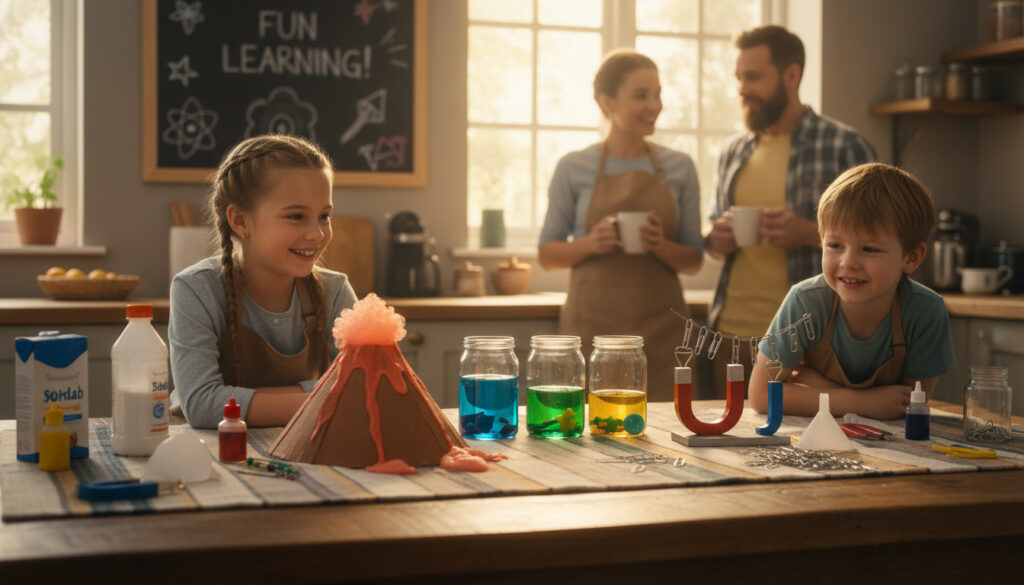
Kids Science Experiments at Home – Easy Household Activities
Transforming everyday kitchen ingredients into fascinating scientific discoveries requires no laboratory equipment or advanced degrees. Parents and educators increasingly turn to household materials to introduce children to fundamental concepts in chemistry, physics, and biology through immediate, hands-on experimentation that creates visible, memorable results.
Simple items like baking soda, vinegar, milk, and food coloring become tools for exploration that spark curiosity in young minds. These activities demonstrate complex principles including surface tension, density, and chemical reactions while keeping children engaged with tangible outcomes.
From watching colors dance across milk surfaces to inflating balloons with gas expansion, accessible science experiments prioritize observation and discovery over technical precision. This approach makes scientific inquiry available to families regardless of budget constraints or space limitations.
Easy Science Experiments for Kids at Home Using Household Items
Baking soda and vinegar experiments create immediate gas expansion visible through balloon inflation or bubbling reactions, requiring only pantry staples.
Milk and dish soap demonstrations reveal surface tension properties as colors swirl and separate in unexpected patterns across the liquid.
Sink or float tests using water containers help children predict and observe how different materials interact with liquids based on physical properties.
Paper towel experiments show how water travels against gravity, mixing colors across connected surfaces to demonstrate absorption.
- All experiments utilize materials found in typical kitchen pantries or easily obtained from convenience stores
- Most activities complete within five to twenty minutes, accommodating short attention spans
- Hands-on observation creates memorable foundations for complex scientific concepts
- No specialized laboratory equipment or expensive microscopes required
- Activities introduce chemistry, physics, and biology through age-appropriate demonstrations
- Structured questioning before experiments enhances critical thinking skills
- Physical results provide immediate feedback that reinforces cause-and-effect relationships
| Experiment | Age Range | Primary Materials | Duration | Core Concept |
|---|---|---|---|---|
| Baking Soda Balloon | 4+ years | Baking soda, vinegar, bottle, balloon, funnel | 10 minutes | Chemical reaction/Gas expansion |
| Magic Milk | 3+ years | Whole milk, food coloring, dish soap, cotton swab | 5 minutes | Surface tension disruption |
| Crawling Rainbow | 4+ years | Paper towels, cups, water, food coloring | 20 minutes | Capillary action/Color mixing |
| Sink or Float | 3+ years | Container, water, coins, buttons, cork, toys | 15 minutes | Buoyancy/Density |
| Homemade Lava Lamp | 5+ years | Clear bottle, oil, water, food coloring, Alka-Seltzer | 10 minutes | Density/Chemical reaction |
| Skittles Diffusion | 4+ years | Plate, Skittles, warm water | 1-5 minutes | Diffusion/States of matter |
Safe and Age-Appropriate Science Experiments for Children
Designing Activities for Different Developmental Stages
Activities specifically designed for preschool and kindergarten-aged children emphasize sensory exploration and immediate cause-and-effect relationships. Easy Science Projects for Kindergarten and Preschool Teachers provides frameworks that align with early learning standards while maintaining safety through non-toxic materials.
Toddlers engage successfully with simple observation activities like the Magic Milk experiment, which requires only a shallow dish to contain the activity. The Sink or Float test allows young children to handle small objects including coins, buttons, balls, paperclips, and cork while learning prediction skills.
Body System Exploration for Young Learners
Experiments like the Hopping Marshmallow demonstrate circulatory system concepts, while the Water Bottle Test illustrates respiratory mechanics. These activities let children discover how their own biological systems function safely under adult guidance.
Adult oversight remains essential even when using household items. The Water Bottle Test should be done specifically in a sink to prevent spills, while small objects in Sink or Float experiments present choking hazards for children under three.
Popular Baking Soda, Vinegar, and Balloon Experiments
The Classic Balloon Inflation Reaction
The Baking Soda and Vinegar Balloon Experiment stands as a classic introduction to chemical reactions. Participants need baking soda, vinegar, balloons, empty plastic water bottles, a funnel, and a measuring spoon. When combined, vinegar and baking soda create a large reaction with minimal materials, producing carbon dioxide gas that inflates the attached balloon.
This experiment combines excitement with fundamental scientific principles, illustrating gas expansion through visible balloon growth. The reaction occurs immediately, providing instant feedback that maintains young learners’ attention.
Homemade Lava Lamp Chemistry
Creating a homemade lava lamp requires a clear bottle filled three-quarters with oil, topped with water and drops of food coloring. Adding Alka-Seltzer tablets causes bubbles to rise and fall continuously, demonstrating density differences between oil and water alongside chemical reaction principles. At-home science experiments detailed by Prescolaire describe how this activity delves into density and chemical reactions simultaneously.
Why Home Science Experiments Benefit Kids and Setup Tips
Cognitive Foundations and Engagement
Hands-on activities spark curiosity and lay the foundation for understanding fundamental scientific concepts that serve as building blocks for future science exploration. Children witness scientific principles firsthand, creating memorable learning experiences that transcend textbook explanations. According to educational resources, the best way to get kids excited about science is through involvement with hands-on experiments using regular household items.
Practical Implementation Strategies
Successful execution requires gathering students first and introducing concepts with questions before beginning experiments. Using readily available materials ensures accessibility, while minimizing mess through strategic container choices keeps cleanup manageable.
Whole milk produces optimal results for surface tension demonstrations, while clear bottles maximize visibility for density experiments. All items are typically found in kitchens or easily obtained from convenience stores, requiring no beakers, microscopes, or expensive lab equipment. For those interested in learning more, early pregnancy signs provides detailed information on early pregnancy signs.
Overfilling balloons with baking soda can cause ruptures during the chemical reaction. The Skittles diffusion experiment requires warm water specifically—cold water dramatically slows the process, extending beyond the typical 27-second color diffusion timeframe.
How Often Should Kids Do Science Experiments?
- Week 1: Observation Foundations – Sink or Float activities build prediction abilities and systematic observation skills using familiar objects.
- Week 2: Color and Chemistry – Magic Milk and Skittles Diffusion introduce chemical observation and physical change concepts through vibrant visual feedback.
- Week 3: Reaction Dynamics – Baking Soda Balloon and Lava Lamp demonstrations explore gas expansion and density through hands-on manipulation.
- Week 4: System Integration – Crawling Rainbow experiments combine capillary action, color mixing, and water absorption for complex multi-concept learning.
Top 32 Easy Science Experiments for Kids at Home provides additional weekly sequencing options that progressively build scientific reasoning capabilities.
What Safety Facts Are Established Versus Unclear?
| Established Information | Information That Remains Variable |
|---|---|
| Adult supervision required for all activities involving small objects or chemical reactions | Exact age when children can conduct experiments independently without oversight |
| Household items like vinegar and baking soda create safe, non-toxic reactions suitable for home use | Duration of engagement varies significantly by individual child attention spans and interest levels |
| Mess minimization possible through use of shallow dishes and sink-contained activities | Specific quantity of materials needed for optimal results in varying home environments |
| Most activities complete within 5-20 minutes, accommodating short attention spans | Long-term retention rates of scientific concepts introduced at different developmental stages |
Why Kitchen Science Matters for Early Development
Accessible experimentation removes barriers to STEM education by demonstrating that scientific inquiry requires expensive equipment or specialized spaces. Easy science experiments to do at home catalogued by National Geographic Kids emphasize how body-system activities create personal connections to abstract biological concepts.
The approach aligns with constructivist learning theories, where children build knowledge through direct experience rather than passive instruction. Teacher-vetted experiments confirm that regular exposure to hands-on science correlates with increased comfort regarding scientific inquiry and problem-solving approaches.
Expert Perspectives on Early Childhood Science
These experiments spark curiosity and lay the foundation for understanding fundamental scientific concepts that serve as building blocks for future science exploration.
Educational Resources, Easy Science Projects for Kindergarten and Preschool Teachers
The best way to get kids excited about science is through involvement with hands-on experiments using regular household items.
Teaching Strategies, We Are Teachers
Additional frameworks available through Science Buddies and Exploratorium Science Snacks provide structured guidance for parents extending home experimentation into detailed inquiry projects.
Getting Started with Home Science Today
Beginning with simple Sink or Float tests or the immediate visual feedback of Skittles diffusion requires minimal preparation while establishing routines of scientific observation. NASA STEM resources offer complementary extension activities for families ready to advance from kitchen chemistry to aerospace exploration, building progressively on the foundational concepts introduced through these accessible household experiments.
Frequently Asked Questions
What household items can I use for kids science experiments?
Baking soda, vinegar, balloons, food coloring, whole milk, dish soap, cotton swabs, paper towels, clear bottles, vegetable oil, water, Alka-Seltzer tablets, and Skittles cover the primary activities described.
What are no-mess science experiments for kids?
The Magic Milk experiment uses a shallow dish to contain all activity, while the Water Bottle Test should be done specifically in a sink to prevent spills and minimize cleanup requirements.
Can toddlers do science experiments at home?
Toddlers can participate in supervised activities like Sink or Float and Magic Milk, though small objects including buttons and paperclips require constant adult oversight to prevent choking hazards.
How do you make a volcano science experiment at home?
Combine baking soda and vinegar in a bottle or container to create bubbling reactions that simulate volcanic eruptions, demonstrating gas expansion and chemical change through visible fizzing.
What are kitchen-based science experiments?
Activities using edible materials including milk, food coloring, vinegar, baking soda, and oil allow children to explore chemistry and physics using ingredients found in standard pantries.
How to explain science concepts during home experiments?
Introduce concepts with questions before beginning, then connect visible results to abstract principles using age-appropriate vocabulary about reactions, density, surface tension, or absorption.
What are the best free science experiment ideas for home?
Skittles Rainbow Diffusion, Sink or Float tests, and Crawling Rainbow require only common household items with no additional purchases necessary, making them genuinely accessible.
More related posts
 Skoda Kamiq for Sale: Worth Buying in Ireland
 Find Remote Work: Top Platforms and Jobs for 2025
 Irish Social Welfare Early October Payments – Dates and Full Schedule
 What Time Does Dunnes Close? Hours & Pay Info
 Size 12 in EU: Clothing & Shoe Conversion Chart (UK to European)
 Pinched Nerve in Neck: Symptoms, Causes, and Home Release
 Diary of a Wimpy Kid Costume: DIY Guide & Printable Masks
 Speed Test – Understand Internet Performance Better
