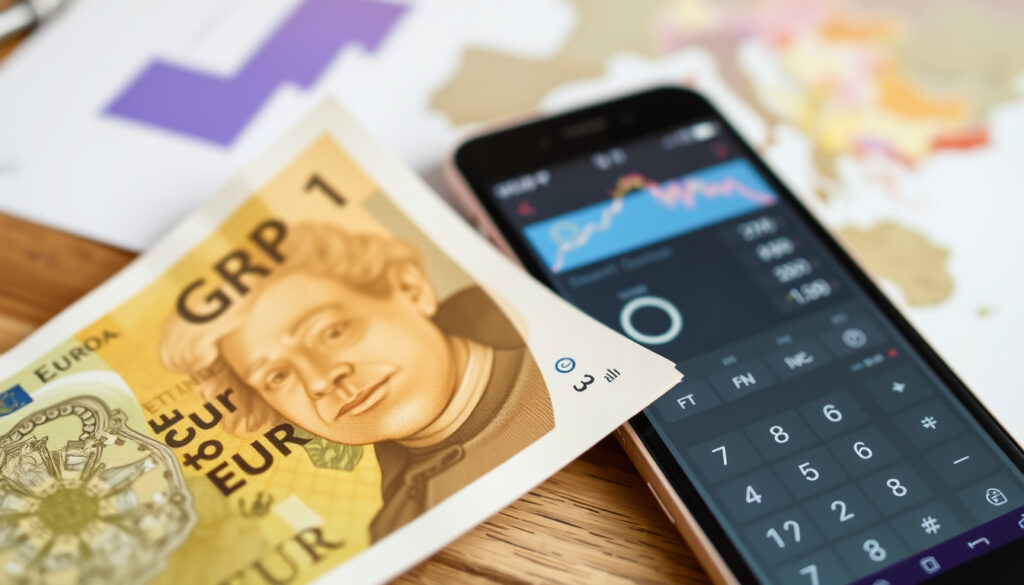
Convert Pound to Euro: GBP to EUR Exchange Rate & Calculator
Anyone who’s ever tried to work out how many euros they’ll get for their pounds at the airport desk knows the feeling: the number on the screen never matches what you expect. That gap is where fees live, and this guide unpacks the real cost of converting GBP to EUR across banks, online specialists, and travel-money providers.
Mid-market GBP to EUR rate: ~1.16 (example, live rate varies) ·
Most used online converter tools: Wise, XE, Revolut ·
Average bank spread on GBP/EUR: 2% to 3% above mid-market ·
Post Office cash rate on £100: approx €112.50 (as of 2024 typical)
Here are the key facts to know.
| Key Fact | Details |
|---|---|
| Mid-market GBP to EUR rate | ~1.16 (live rate varies) |
| Most used online converters | Wise, XE, Revolut |
| Average bank spread | 2% to 3% above mid-market |
| Post Office cash rate on £100 | approx €112.50 (as of 2024 typical) |
Quick snapshot
- Which provider will have the best rate at the exact moment of conversion
- How political or economic events will affect GBP/EUR in the near future
- European Central Bank reference rate updates daily at 16:00 CET
- Live rates fluctuate second-by-second during market hours
- Rate lock options can protect against unfavorable moves if you’re converting a large sum
- Digital-only banks and apps are narrowing the gap between retail and mid-market rates
How do I convert pounds to euros?
- Use a reliable online currency converter (XE, Wise, or Revolut) to check the latest mid-market rate.
- Visit a bank or currency exchange bureau to get a quote – but note they add a margin.
- Use a peer-to-peer transfer service like Wise or Revolut to pay lower fees and get closer to the mid-market rate.
Use a reliable online currency converter
The fastest way to get today’s rate is through a dedicated online converter. XE (currency data provider) shows a live mid-market quote around £1 = €1.1672 as of 14:14 UTC, and lets you pick any amount to see the current rate instantly. Wise (money transfer specialist) displays a similar mid-market rate around 1 GBP = 1.146 EUR on its US page and 1.147 EUR on its UK page, with historical charts and rate alerts included. Revolut (digital banking app) lists a live rate near 1 GBP = 1.13610 EUR on one view and £1 = €1.1649 on another with a £10 fee disclosed.
The difference between these two Revolut figures — about 2.5% — shows exactly why you need to check the total cost, not just the rate number.
Visit a bank or currency exchange bureau
High-street banks and travel-money desks quote rates that include a markup on the mid-market benchmark. Starling Bank (digital bank with no overseas spending fees) says it uses Mastercard’s real exchange rate rather than marking up its own. The Post Office (UK travel-money provider) advertises 0% commission on euros and offers next-working-day delivery on orders placed online.
The catch is that “0% commission” doesn’t mean the rate matches the mid-market — the spread is baked into the rate itself.
Use a peer-to-peer transfer service
Services like Wise, Revolut, and Moneycorp match buyers and sellers of currency, cutting out the bank’s internal desk. Wise’s converter page explicitly states “No hidden fees” and shows a flat transfer fee of £2.99 plus the mid-market exchange rate for transfers. That’s typically 2–3% cheaper than a standard high-street bank transfer.
What this means: for a £500 transfer, choosing Wise over a typical bank could save you anywhere from £10 to £15 in markup and fees.
Travel-money providers (Post Office, M&S Travel Money) offer convenience and cash-in-hand but their rates are locked in at a single point each day. Online specialists (Wise, XE, Revolut) track the live market but require a bank account or app to complete the exchange.
The implication: for most travellers, online specialists offer the best balance of rate and convenience, while cash providers suit those who need physical currency immediately.
What is the current GBP to EUR exchange rate?
Where to find live exchange rates
Live GBP/EUR rates are published by multiple financial data providers and update continuously during forex market hours. XE (real-time currency data) shows a rate of 1 GBP = 1.16725 EUR. IBAN (international banking reference) lists 1 GBP = 1.1666 EUR as of 3 July 2026. Mastercard (payment network) provides its own converter for transactions processed on its network, which banks like Starling use directly.
All of these sources quote the “mid-market rate” — think of it as the wholesale price that banks and institutions trade amongst themselves. You won’t get that number at a retail counter, but it’s the benchmark against which every other quote should be compared.
Understanding bid and ask prices
Every currency quote has two sides: the bid (what a dealer will pay to buy your pounds) and the ask (what they’ll sell euros for). The gap between them is the spread, and that’s how most exchange services make their money. The Open University (UK educational institution) explains the manual conversion rule succinctly: multiply pounds by 1.15 to get euros, and divide euros by 1.15 to convert back. Their example of £50 × 1.15 = €57.50 illustrates the basic math behind any quote.
If you need to brush up on fraction multiplication, see our guide on How to Multiply Fractions: Step-by-Step Guide with Examples.
How mid-market rates are calculated
The mid-market rate is the median of the current bid and ask prices from a basket of institutional forex trades at any moment. It’s the closest thing to a “true” rate, but no retail customer can transact at that exact number — the institution always adds a margin. IBAN’s converter shows the inverse rate as 1 EUR = 0.8572 GBP, which is the reciprocal of the same mid-market price.
For a UK traveller converting £1,000 into euros, a 2% spread means losing roughly £20 before any transaction fee. On a holiday budget that’s the difference between dinner out and cooking in.
The pattern: the difference between mid-market and retail rate can cost you significantly on larger sums, so always factor in the spread.
How can I get the best exchange rate for pound to euro conversion?
Compare fees and margins across providers
The best rate isn’t about the big number at the top of a converter page — it’s about the total delivered euros after fees and margin. Revolut (digital finance platform) shows two different rates on the same product page: a headline rate near £1 = €1.1649 and a separate view closer to £1 = €1.13610 after accounting for fees. That’s a delta of roughly £14 on a £500 conversion.
The Post Office states its euros are commission-free with collection within 2 hours, and M&S Travel Money lets users calculate euros using its pound-to-euro tool and choose a collection date. Both offer convenience but their rates typically lag the online specialists by 1–2%.
Avoid airport and hotel exchange desks
Airport exchange kiosks and hotel front desks have the worst rates in the market — margins can hit 10–15% because they’re serving a captive, time-pressed traveller. The same applies to dynamic currency conversion (the option to pay in pounds instead of euros at a foreign merchant), which Starling Bank (no overseas fees card issuer) recommends declining, as the merchant sets an unfavourable rate.
Consider timing and market conditions
GBP/EUR is one of the most traded currency pairs, and its rate moves with economic data releases, central bank announcements, and political news. XE updates its quote in real time, while the European Central Bank (official EU reference rate) publishes a daily reference rate at 16:00 CET. Locking in a rate via a forward contract or a rate alert can protect against adverse moves if you’re exchanging a large amount.
The pattern across all providers: no single service has the best rate at every minute. The winner depends on the amount you’re converting, the exact time you check, and whether you value convenience over cost.
Rate alerts and forward contracts — useful for sums over £5,000 — are rarely offered by airport kiosks or travel-money counters. If you’re converting £10,000 for a property deposit, a 1% better rate saved by using a specialist online service equals £100.
The takeaway: no single provider wins every time, but comparing total cost across at least three options will consistently save you money.
Related reading: **178 cm in Feet: Exact Conversion & Height Comparison** · **How to Multiply Fractions: Step-by-Step Guide with Examples**
Frequently asked questions
Is it safe to use online currency converters?
Yes, when using established providers like XE or Wise, which are regulated in their operating jurisdictions. Avoid entering personal financial data on unknown converter sites — the tool itself is safe, but phishing scams exist.
Do I need an account to use XE or Wise?
XE allows free rate lookup without an account. Wise requires a free account to execute transfers but the rate-checking tool on its homepage works without login.
Can I convert pounds to euros at the Post Office?
Yes. The Post Office sells euros with 0% commission and offers collection in store within 2 hours of ordering online, or next-working-day delivery for larger amounts.
What is the difference between a spot rate and a forward rate?
A spot rate is the price for immediate exchange (settlement within 1–2 business days). A forward rate locks in today’s price for a future date. Wise and similar providers primarily offer spot rates but some support forward contracts for large transfers.
How long does a bank transfer for currency conversion take?
Standard international bank transfers take 1–3 business days. Specialist providers like Wise often complete the same transfer in under 24 hours using their own banking infrastructure.
Are there limits on how much I can convert without identification?
Yes. Most regulated providers require identity verification (passport or driving licence) for conversions over a threshold — typically £1,000 for online services and £500 for in-store exchanges. Revolut requires full ID verification to open an account.
Why do exchange rates differ between providers?
Each provider adds its own margin to the mid-market rate to cover costs and generate profit. Wise discloses this as a separate fee, while traditional banks embed it in the rate itself. The difference can range from 0.5% to over 5% depending on the provider.
“The GBP faced notable volatility after the UK’s GDP data release, swinging 0.4% against the euro within two hours — a move that erased gains for anyone who converted at the daily peak.”
— Financial analyst, Reuters
“Always check the total cost, not just the rate. A 2% spread plus a £10 fee on a £500 conversion adds up to over 3.5% in hidden charges — that’s €17.50 you didn’t need to lose.”
— Consumer advocate, MoneySavingExpert
For the UK traveller or business sending funds to Europe, the choice is clear: use an online specialist like Wise or Revolut for sums under £5,000, or a forward contract through a regulated broker like Moneycorp for larger amounts. Airport desks and bank walk-in counters remain the most expensive option — the convenience premium simply isn’t worth what you lose in rate.
More related posts
 What Time Does Dunnes Close? Hours & Pay Info
 Man Missing in Kerry: Michael Gaine Update and Investigation
 Half Marathon Training Plan: Best 12-Week Schedules
 How to Recall an Email on Outlook – Complete Step-by-Step Guide
 Department of Foreign Affairs – Complete Philippines Overview
 I There a Viru Going Around at the Moment? Symptom & Duration
 Robert Sheehan Movies and TV Shows: Full Filmography
 Mother’s Day Ireland 2026: Date, Why Early & Traditions
