Irish Army Ranger Wing: Roles, Training, Selection
Ireland keeps a small but sharp special operations force tucked away at the Curragh Camp in County Kildare, and the soldiers who make it through its notorious selection course earn something few Irish military personnel ever do: a green beret. Yet the Defence Forces spend roughly €1 million and four years training each one of those soldiers—and still struggle to retain them against private sector alternatives that value exactly these skills. Former rangers have spoken publicly about being forced out by pay that doesn’t match the gruelling demands of the job.
Official Designation: Sciathán Fianóglach an Airm · Parent Organization: Irish Defence Forces · Entry Route: Serving members only · Primary Roles: Conventional warfare and specialist ATCP
Quick snapshot
- ARW formed in 1980 from Ranger-trained IDF personnel (Boot Camp Military Fitness Institute)
- Exclusively serving Defence Forces members eligible (Irish Defence Forces Official)
- SOFQ Course: 40 weeks, 5 modules, annual intake (Wikipedia)
- Official world ranking or tier classification
- Current exact pass rate and personnel numbers
- Detailed breakdown of base salary beyond allowances
- 1969: First Ranger Selection Course with 12 students
- 1980: ARW formally established
- 2014: SOFQ introduced as 34–40 week course
- 2025 recruitment cycle likely October
- Ongoing pay disputes may affect retention
The table below consolidates key ARW identifiers from official sources.
| Field | Value |
|---|---|
| Full Name | Army Ranger Wing (ARW) |
| Irish Name | Sciathán Fianóglach an Airm |
| Affiliation | Irish Army, Defence Forces |
| Membership | Serving soldiers only |
What does the Irish Army Ranger Wing do?
The Army Ranger Wing serves as Ireland’s dedicated special operations force within the Defence Forces. Unlike regular infantry units, ARW personnel conduct missions that require advanced tactical capabilities beyond conventional warfare parameters. According to the Irish Defence Forces official page, the unit handles operations where precision, specialized training, and rapid deployment are essential.
Conventional warfare roles
ARW supports conventional military operations when called upon. This includes direct action missions, reconnaissance, and providing elite tactical capabilities to larger force elements. The unit trains alongside international partners including US Army Special Forces, exchanging techniques and maintaining interoperability with allied special operations communities.
Specialist ATCP roles
The acronym ATCP stands for Anti-Terrorist Crisis Prevention, a term the Irish Defence Forces uses for counter-terrorism operations. ARW maintains readiness for hostage rescue, high-value target capture, and other scenarios requiring surgical precision. The unit’s location at Curragh Camp provides access to training grounds suitable for urban, rural, and wilderness scenarios across Ireland’s varied terrain.
How to join the Irish Army Ranger Wing?
Civilians cannot apply directly to the Army Ranger Wing. This is one of the most important eligibility facts that surprises people researching ARW careers. The official Defence Forces careers page explicitly states that candidates must be serving members of the Permanent Defence Forces before they can attempt selection.
Eligibility requirements
Candidates must meet several baseline criteria before their names can enter the selection pipeline. They must be serving soldiers, sailors, or air corps personnel with at least the rank of 3 Star Private or equivalent. Medical fitness standards are stringent, and candidates undergo initial screening before the formal selection course begins. Women have been eligible since 1984, though none have successfully completed the course as of the most recent public reporting.
Selection process overview
The SOFQ (Special Operations Force Qualification) Course represents the gateway to earning the green beret. The annual course typically runs in autumn, with Module 1 serving as the initial assessment phase that determines who continues. The Defence Forces have trimmed selection duration over the decades—from an original four-week format to three weeks by 2006, before the current SOFQ structure consolidated selection and training into a single extended programme.
What is Irish Army Ranger Wing training?
The Special Operations Force Qualification Course replaced earlier selection and training formats around 2014. This 40-week programme represents one of the most demanding military training courses in Europe, designed to build operators capable of functioning across the full spectrum of special operations.
Selection and training phases
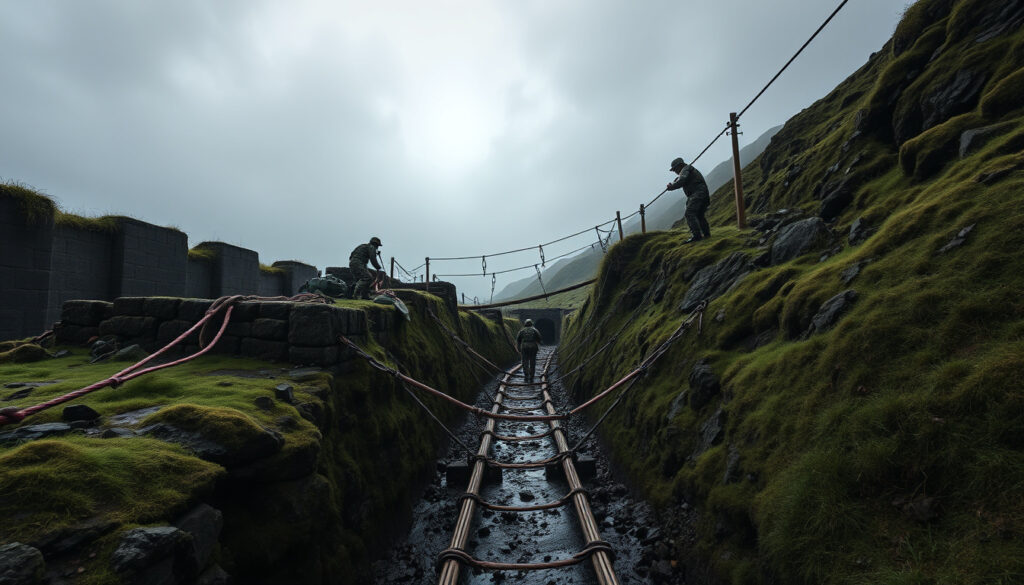
Module 1 spans three weeks and functions as the primary screening mechanism. According to the Irish Defence Forces official selection page, candidates face continuous assessment in fitness, navigation, water confidence, and psychological pressure tolerance. The module culminates in a final march of 60–65 kilometres carrying loads between 29.5 and 65 pounds. The Journal reported in 2024 that this “Hell Week” includes a 12km mountain march over challenging terrain including bogs, forestry, and scree peaks like Scar, Brockagh, and Tonelagee.
Modules 2 through 4 build on the survival foundations established in Module 1. Candidates receive weapons training, marksmanship development, live-fire exercises, and special operations tactics including close quarters battle (CQB). Water survival, SERE (Survival, Evasion, Resistance, Escape), communications, and combat medical skills round out the intermediate phases.
Those who progress receive the Fianóglach tab after Module 3, signalling provisional assignment to the unit. The green beret—the symbol most recognizable to the public—arrives only after completing Module 4 successfully.
Specialist skills like sniper roles
Advanced sniper capabilities form part of the ARW skill set, though specific details about sniper training remain guarded. The unit’s training relationship with US Army Special Forces (Green Berets) has influenced doctrine development, particularly in precision shooting and reconnaissance. Ex-rangers who have spoken publicly have mentioned specialized marksmanship training as a significant part of their operational preparation.
How good is the Army Ranger Wing?
Measuring special operations forces against each other invites speculation, but the ARW has demonstrated its capabilities through real operations and joint training exercises. The unit has participated in UN peacekeeping missions, maritime interdiction operations, and provided support during national emergencies within Ireland.
Tier and world ranking
International rankings of special operations forces are inherently subjective, depending heavily on what criteria analysts prioritize. Grey Dynamics estimates ARW personnel at around 150, a small footprint that nonetheless represents concentrated capability. The unit’s training partnerships with US Special Forces and other NATO special operations commands suggest peer recognition from more established SOF communities.
Direct comparisons to the UK’s SAS or US Delta Force lack public official data, making precise tier placement speculative. What is documented is the ARW’s operational tempo and the standards maintained for selection—this is not a unit that admits marginal candidates.
Comparisons to units like SAS
The SAS and similar Tier 1 US units operate with significantly larger budgets, more personnel, and decades more institutional experience. The ARW, by contrast, maintains a lean structure appropriate to Ireland’s defence needs. Joint training exercises provide the closest metric for comparison: Irish rangers training alongside SAS or US operators do not appear to be operating at a different level, though the operational scale differs substantially.
What tier is the Irish Army Ranger Wing?
Military analysts typically classify special operations forces in tiers, but official tier classifications are not published by the Irish Defence Forces. What is known from reporting by the Irish Examiner and other sources is that the unit occupies a distinct position within Ireland’s defence architecture—elevated above conventional forces but operating under different legal authorities than some international counterparts.
Requirements and age limit
There is no stated maximum age limit for ARW selection, which distinguishes the Irish programme from some international equivalents where upper bounds apply. The practical limitation tends to be physical recovery time—older candidates face longer adaptation periods—and the requirement that candidates already have meaningful service experience before attempting selection. The minimum rank of 3 Star Private or equivalent effectively creates a de facto experience filter.
Salary and retention issues
This is where the ARW story takes an uncomfortable turn. The Irish Examiner reported in detail that poor pay has forced experienced rangers out of the force despite completing the gruelling selection process. The Defence Forces Arbitration Board recommended allowance increases in October 2021, which were implemented in 2023 with backpay. Post-adjustment figures show ARW allowances for officers ranging from €216.48 to €279.07 per week, with enlisted personnel (post-2013 entry) receiving €225.62 to €288.15 per week.
For context: the training investment per ranger is approximately €1 million and four years according to the Irish Examiner. Losing rangers to better-paying jobs in the private security sector or emigration represents a significant return on that investment flowing out of the Defence Forces. Former rangers quoted by the Irish Examiner described being unable to afford continuing careers in a unit that demands exceptional physical risk and sustained operational readiness.
Only two candidates completed the full SOFQ course in 2019, according to Grey Dynamics. High attrition compounds the training cost problem—when few enter and fewer finish, the per-capita investment balloons even as the unit struggles to maintain strength.
The training timeline shows how Ireland has consolidated its selection process over decades.
| ARW Course Phase | Duration | Key Content | Source |
|---|---|---|---|
| Historical Selection (pre-SOFQ) | 4 weeks (3 from 2006) | Water confidence, assault course, land navigation, combat run | Boot Camp Military Fitness Institute |
| Historical Basic Skills (pre-SOFQ) | 6 months | Combat survival, CQB, medical, diving, parachuting | Boot Camp Military Fitness Institute |
| SOFQ Module 1 | 3 weeks | Fitness, navigation, claustrophobia/water tests, 60-65km march | Irish Defence Forces Official |
| SOFQ Modules 2-4 | ~25 weeks | Weapons, live-fire, SOF/CT tactics, water survival, SERE | Irish Defence Forces Official |
| SOFQ Module 5 | Remaining weeks | Advanced specializations, command suitability testing | Irish Defence Forces Official |
The transition from separate courses to the consolidated SOFQ represents a philosophical shift toward treating selection as an ongoing evaluation rather than a single gateway event.
The comparison below illustrates how training has evolved since the programme’s last major overhaul.
| Category | Historical (pre-2014) | Current (SOFQ) | Difference |
|---|---|---|---|
| Selection duration | 3-4 weeks standalone | 3 weeks (Module 1 of 5) | Now integrated into longer programme |
| Total course length | Selection + 6 months skills | 40 weeks (10 months) | ~2× longer total investment |
| Candidates per year | 40-80 | Varies (9 completed Module 1 in 2015) | Lower pass rates recently |
| Output | Separate qualified operators | Integrated unit assignment | Earlier provisional status now |
| Module phases | Selection → Skills | 5 sequential modules | More granular progression |
Three distinct eras of ARW training show a clear pattern: consolidation from separate selection and skills courses into a single integrated pipeline, expansion of total duration from weeks to months, and increasing emphasis on officer command suitability alongside raw operator skills.
These metrics capture the financial and operational scope of maintaining ARW capability.
| Metric | Value | Source |
|---|---|---|
| ARW formation year | 1980 | Boot Camp Military Fitness Institute |
| First Ranger Selection Course | 1969 (12 students) | Boot Camp Military Fitness Institute |
| SOFQ duration | 40 weeks (5 modules) | Wikipedia |
| Module 1 final march | 60-65 km with 29.5-65lb load | Irish Defence Forces Official |
| Training cost per member | €1 million + 4 years | Irish Examiner |
| Estimated ARW personnel | 150 | Grey Dynamics |
| Allowance review date | October 2021 | Irish Examiner |
| Allowance implementation | 2023 (with backpay) | Irish Examiner |
| Officer allowance (post-adjustment) | €216.48 – €279.07/week | Irish Examiner |
| Enlisted allowance (post-2013) | €225.62 – €288.15/week | Irish Examiner |
| Attrition (2019 full course) | 2 completed | Grey Dynamics |
Spec tables rarely tell the human story, but these numbers contain it: years of investment per operator, modest allowances after recent increases, and attrition figures that suggest the SOFQ remains brutally selective.
Upsides
- Elite training recognised through international joint exercises
- No upper age limit expands candidate pool
- Allowance increases implemented since 2023
- Clear progression from tab to green beret
- Serving members already have military foundations
Downsides
- No direct entry path for civilians
- High attrition limits unit growth
- €1m investment per operator at risk from pay-driven exits
- Pay still lags private security sector alternatives
- No official public ranking or tier classification
The ARW operates with proven capabilities but faces a structural retention problem: it trains soldiers to a level that commands premium compensation in the private sector, then struggles to compete on salary alone. The 2023 allowance increase was a necessary step, but whether it proves sufficient will determine whether the unit can maintain its small but capable footprint.
Steps: How to attempt ARW selection
For serving Defence Forces members considering the path to the green beret, the process follows a predictable sequence. While the Defence Forces do not publish detailed selection blueprints, public sources and former member accounts sketch the essential steps.
- Confirm eligibility: Ensure you hold at least 3 Star Private rank or equivalent and have passed basic medical screening. Active duty status in Army, Air Corps, or Naval Service is required.
- Monitor official announcements: The SOFQ course runs annually, typically in autumn. Official Defence Forces channels announce upcoming cycles.
- Prepare physically: The Module 1 final march demands 60-65km completion with loads exceeding 29 pounds. Water confidence, navigation skills, and sustained endurance are tested continuously.
- Register through chain of command: Unlike civilian job applications, ARW candidacy requires unit endorsement through your existing chain of command.
- Complete Module 1: Three weeks of continuous assessment eliminates marginal candidates. Those who pass advance to Modules 2-4.
- Earn the Fianóglach tab: After Module 3, provisional assignment to ARW is confirmed and the tab is awarded.
- Complete Module 4: The green beret ceremony marks full qualification as an Army Ranger.
- Continue professional development: SOFQ tests planning and decision-making for officer command suitability, meaning career advancement continues post-qualification.
No female candidate has successfully completed the ARW course since eligibility opened in 1984. This reflects the physical demands of the programme rather than any formal barrier, but it remains a notable gap in the unit’s demographics.
Confirmed facts
- ARW is the special operations force of the Irish Defence Forces
- Selection is open only to serving PDF members
- SOFQ replaced earlier selection/training formats circa 2014
- Module 1 culminates in a 60-65km loaded march
- Training costs approximately €1 million per operator
- Allowance increases were implemented in 2023 following 2021 recommendation
What’s unclear
- Official published tier classification or world ranking
- Current precise pass rates and active personnel count
- Complete breakdown of ARW base salaries versus allowances
- Whether female candidates have recently come closer to passing
- Full details of Module 5 content
“Our ultimate hell”: Former rangers describe how poor pay forced them out of a unit that demands exceptional physical risk and sustained operational readiness.
— Irish Examiner, investigative reporting on ex-ranger testimonies
Potential candidates for the Ranger Wing must now undergo a five-module course, lasting a total of 34 weeks.
— Military fitness author, 2014 analysis of SOFQ structure
On 2015-10-10, 9 candidates completed the first SOFQ Module 1 after 250km marches carrying loads up to half their body weight, culminating in a 65km final march.
— Boot Camp Military Fitness Institute, historical training record
Related reading: Counties of Ireland
Frequently asked questions
What is the ARW in the Irish Defence Forces?
The Army Ranger Wing (ARW) is Ireland’s dedicated special operations force, operating as an elite unit within the Defence Forces. Its official Irish name is Sciathán Fianóglach an Airm.
Can civilians apply directly to the Army Ranger Wing?
No. The Defence Forces explicitly state that only serving members of the Permanent Defence Forces are eligible for ARW selection. There is no direct civilian entry route.
What operations has the Irish Army Ranger Wing conducted?
ARW has participated in UN peacekeeping missions, maritime interdiction operations, and provided support during national emergencies. Specific mission details remain classified, but the unit maintains operational readiness for counter-terrorism and direct action scenarios.
How does ARW training compare to regular army?
ARW training is qualitatively different from standard military instruction. The 40-week SOFQ exceeds most conventional training programmes in duration, intensity, and specialization. Only a fraction of candidates complete the course, with Module 1 alone eliminating the majority.
What is the role of snipers in the Army Ranger Wing?
Sniper capabilities form part of the ARW’s advanced skill set, developed through training relationships with international partners including US Army Special Forces. Specific details about sniper training progression remain guarded information.
Are there age limits for ARW selection?
There is no stated maximum age limit. The practical limitation tends to be the physical demands of selection and the expectation of meaningful prior service experience before attempting the SOFQ.
What pay issues affect ARW retention?
Former rangers have reported being forced out by pay that did not reflect the demanding and dangerous nature of the work. Allowance increases recommended in October 2021 were implemented in 2023 with backpay, but questions remain about whether compensation now matches private sector alternatives for personnel with equivalent skills.
This article draws on official Defence Forces sources, established specialist publications, and investigative reporting. Salary figures reflect post-2023 allowance implementations. Personnel estimates and attrition figures come from secondary sources and should be treated as approximations where not verified by primary data.
For serving Defence Forces members weighing the ARW path, the calculation is straightforward in theory but difficult in practice: the unit offers elite training and operational experience that few Irish soldiers will ever access, but the financial rewards lag competitors who seek out exactly these capabilities. The 2023 pay adjustment was overdue, and whether it proves sufficient to retain experienced rangers will determine whether Ireland’s special operations capability stays sharp or slowly hollows out. Those already in uniform have the advantage of seeing the unit firsthand before committing to selection—use that opportunity.
More related posts
 Man United vs Liverpool: TV Channel, 3:30 Kickoff, 7-0 Result
 The City Is Ours – McFly’s Kelly Jones Collaboration
 Counties of Ireland in Irish – All 32 Names, Pronunciations & Meanings
 Mortgage Interest Rates Ireland – Current Rates and 2026 Forecasts
 New COVID Isolation Rules Ireland 2025: HSE Guidelines
 Tung Tung Tung Sahur – Viral Ramadan TikTok Trend Explained
 Latest SE Palmeiras Games: Schedule, Results & Fixtures
 Real Madrid vs Espanyol Lineups Today: Predicted XI & Stats
