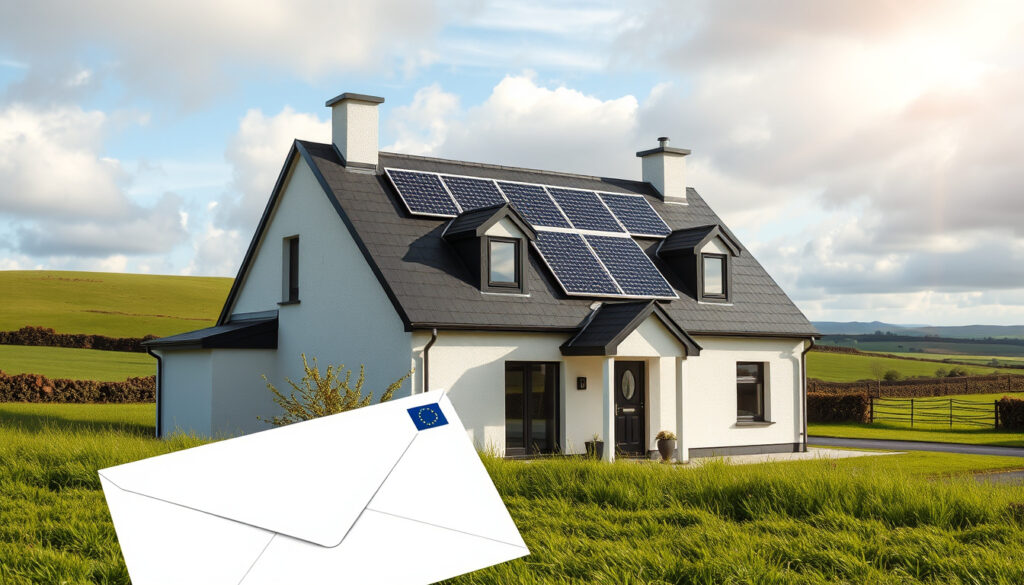
Grant for Solar Panels Ireland: 2026 Amount & Eligibility
Anyone who has checked the SEAI solar grant over the past few years knows the pattern: the maximum amount seemed to edge downward. In 2026, that trend stopped. The grant held at €1,800 for systems 4 kWp and above, giving homeowners a stable benchmark to plan their investment.
Maximum SEAI grant in 2026: €1,800 ·
Minimum system size for full grant: 4 kWp ·
Eligible applicants: Homeowners and private landlords ·
Average solar panel payback period: 5–8 years ·
Typical annual electricity savings: €300–€500
Quick snapshot
- Maximum €1,800 (SEAI (Ireland’s sustainable energy authority))
- For systems 4 kWp or larger (SEAI (Ireland’s sustainable energy authority))
- Administered by SEAI (SEAI (Ireland’s sustainable energy authority))
- Homeowners and private landlords (SEAI)
- Property built before 31 Dec 2020 (SEAI)
- Installation by SEAI-registered contractor (SEAI)
- Typically 5–8 years (Energy Cost Ireland (Irish energy comparison site))
- Depends on self-consumption rate (Energy Cost Ireland (Irish energy comparison site))
- Annual savings €300–€500 (Energy Cost Ireland (Irish energy comparison site))
- High upfront cost even after grant
- Output varies with weather
- Inverter replacement needed after 10–15 years
Six key figures sum up the deal: the maximum grant, the minimum system size, the provider, the last update year, eligible applicants, and the average payback in Ireland.
| Detail | Value |
|---|---|
| Maximum Grant Amount | €1,800 |
| Minimum System Size | 4 kWp |
| Grant Provider | SEAI (Sustainable Energy Authority of Ireland) |
| Year Last Updated | 2026 |
| Eligible Applicants | Homeowners and private landlords |
| Average Payback Period | 5–8 years |
How much of a grant do you get for solar panels?
Eligibility for solar grants in Ireland
- You must be the homeowner or a private landlord – tenants do not qualify (SEAI (Ireland’s sustainable energy authority)).
- The property must have been built and occupied on or before 31 December 2020.
- The installation must be carried out by an SEAI-registered contractor.
- Grant approval must be obtained before any work begins; the payment is made after completion and documentation submission.
Even with the full €1,800 grant, the installer quotation still determines the final outlay — the grant reduces but does not eliminate the cost.
SEAI grant amounts for 2026
The grant is calculated per kilowatt-peak (kWp) of installed capacity. The first 2 kWp receive €700 per kWp, and the next 2 kWp receive €200 per kWp, up to a cap of €1,800 (SEAI).
- 1 kWp system: €700
- 2 kWp system: €1,400
- 3 kWp system: €1,600
- 4 kWp system: €1,800 (maximum)
Maximum grant of €1,800 for 4 kWp systems and above
To receive the full €1,800, your system must be at least 4 kWp. Larger systems do not receive extra from SEAI, though you can benefit from more electricity generation.
The implication: the grant structure strongly favours systems sized between 2 kWp and 4 kWp. Going bigger than 4 kWp gives you more power but no additional grant support.
Is there a grant for solar panels in N Ireland?
Northern Ireland vs Republic of Ireland grant schemes
The SEAI residential solar grant is only available in the Republic of Ireland. Homeowners in Northern Ireland cannot apply (SEAI). There is no direct equivalent scheme from the Northern Ireland government.
Alternative support in Northern Ireland
While no upfront grant exists, Northern Ireland residents can explore the UK-wide Smart Export Guarantee (Ofgem (UK energy regulator)), which pays for electricity exported to the grid. Local energy advice services may also provide guidance on financing options.
The trade-off: Republic homeowners get a meaningful upfront grant; NI homeowners rely on export payments and lower installation costs, but lack the same capital support.
What is the biggest drawback of solar panels?
High upfront costs despite grants
- Even with the €1,800 grant, a typical 4 kWp installation costs around €5,000–€7,000 net (Energy Cost Ireland (Irish energy comparison site)).
- Not every household has the ready cash to cover the remaining balance.
Dependence on weather and daylight
- Irish weather is cloudy, but panels still generate – about 60–70% of the output of a sunny day.
- Winter generation is much lower, so grid reliance remains.
Maintenance and inverter replacement
- Inverters typically need replacement after 10–15 years, costing €800–€1,200 (SEAI (Ireland’s sustainable energy authority)).
- Panels require occasional cleaning to maintain efficiency.
The pattern: the biggest drawback is cash flow – the upfront net cost is high, and the payback period, while reasonable at 5–8 years, locks you in for half a decade before you break even.
Will a 5kW solar system run a house?
Typical Irish household energy consumption
The average Irish home uses about 4,200 kWh of electricity per year (Energy Cost Ireland (Irish energy comparison site)). That figure is the benchmark for sizing a system.
What a 5 kW system can power
A 5 kWp system in Ireland generates roughly 4,000–5,000 kWh annually, depending on orientation and shading. That closely matches the average home’s usage. In practice, a 5 kW system can cover most or all of a typical household’s electricity needs – especially if you shift high-consumption appliances to daylight hours.
Is 10 kW enough for larger homes?
A 10 kWp system produces about 8,000–10,000 kWh per year. This suits households with electric heating, heat pumps, or higher occupancy. The SEAI grant caps at €1,800 regardless, so the extra capacity comes at full cost.
Why this matters: for most Irish homes, 5 kWp is the sweet spot – it meets annual consumption and qualifies for the maximum grant. Going larger only makes sense if your usage is significantly above average.
How many years does it take for a solar panel to pay for itself?
Factors affecting payback period
- Self-consumption rate – the more electricity you use when the sun shines, the faster the payback.
- Electricity price – higher per-kWh rates shorten the payback.
- System size and orientation, grant amount, and export tariff (if any).
Payback in Ireland with the SEAI grant
With the €1,800 grant and net installation costs of €5,000–€7,000, the typical payback period is 5–8 years (Energy Cost Ireland (Irish energy comparison site)). Annual savings on electricity bills can reach €300–€500.
Comparison to other home energy investments
Compared to attic insulation (payback 2–4 years) or a heat pump (8–12 years), solar panels sit in the middle. However, solar panels also provide a hedge against future electricity price increases – a benefit that standard insulation does not offer.
The catch: payback depends heavily on your daily routine. A household that runs appliances during the day will recover its investment far faster than one that only uses power in the evening, when the panels are idle.
Upsides
- Stable grant of €1,800 for 2026
- 0% VAT on supply and installation (Revenue Ireland (Irish tax authority))
- Payback achievable in 5–8 years
- Reduces your electricity bills by €300–€500 annually
- Low maintenance – only inverter replacement after 10–15 years
Downsides
- High upfront cost even after grant (often €5,000–€7,000)
- Output drops significantly in winter
- Payback is sensitive to self-consumption habits
- No grant for systems under 2 kWp
- Inverter replacement adds cost
How to apply for the SEAI solar grant – step by step
Step 1: Check your eligibility
- Confirm you are a homeowner or private landlord, and the property was built before 31 December 2020.
Step 2: Get quotes from SEAI-registered contractors
- Only installers listed on the SEAI register qualify for grant work (SEAI (Ireland’s sustainable energy authority)).
Step 3: Submit your grant application
- Apply online via the SEAI portal before any installation begins. Approval is required first.
Step 4: Complete the installation
- Work must be carried out by the registered contractor to the required standards.
Step 5: Submit post-works documentation
- Upload the invoice, proof of payment, and any required BER certificate (SEAI).
Step 6: Receive the grant payment
- SEAI pays the grant directly into your bank account after verification.
The process takes roughly 8–12 weeks from post-works submission to payment. The grant is paid as a fixed sum, not a percentage, so the exact amount is known upfront.
Timeline signal
- 2026: The SEAI solar grant remained at €1,800 for the first time, breaking a pattern of previous yearly reductions (SEAI (Ireland’s sustainable energy authority)).
This stability is significant: it gives homeowners confidence to plan without worrying that the subsidy will shrink again next year.
Confirmed facts and what remains unclear
Confirmed facts
- SEAI solar grant maximum is €1,800 in 2026.
- Eligible parties: homeowners and private landlords.
- System must be at least 4 kWp for full grant.
- Grant has not been reduced in 2026.
- 0% VAT applies to residential solar panel installation (Revenue Ireland (Irish tax authority)).
What’s unclear
- Exact grant amounts for Northern Ireland – no official SEAI equivalent exists.
- Future grant levels beyond 2026 – no commitment from SEAI.
- Payback period varies widely based on individual usage and electricity rates.
- The exact impact of the 0% VAT rate on final total cost depends on the installer.
What SEAI and Citizens Information say
“Receive government grant of up to €1,800 towards the installation of solar PV for your home.”
SEAI (Ireland’s sustainable energy authority)
“The Solar Electricity Grant can help you with the cost of buying and installing solar photovoltaic (PV) panels for your property.”
Citizens Information Ireland (official public service information)
These statements reinforce the central message: the grant is substantial and designed to offset the upfront cost, but it is not a full subsidy.
For a detailed breakdown of costs and savings, see our guide on solar panels for your home in Ireland.
Frequently asked questions
Can I get a solar panel grant if I am a tenant?
No. Only homeowners and private landlords are eligible for the SEAI residential solar grant. Tenants cannot apply.
Do I need planning permission for solar panels in Ireland?
Generally no, for roof-mounted panels up to 50 sqm on detached houses, under exempted development. Always check with your local authority.
How do I apply for the SEAI solar grant?
Apply online through the SEAI portal before installation starts. You need a quote from an SEAI-registered contractor and confirmation of eligibility.
Is there a grant for solar panels in the UK?
Yes, the UK has the Smart Export Guarantee (SEG), which pays for exported electricity. There is no upfront grant equivalent to the SEAI scheme.
What happens if I move house after installing solar panels with a grant?
The grant is tied to the property. If you sell, the new homeowner benefits from the installed system, but no repayment is required.
Can I combine the solar grant with other SEAI home energy grants?
Yes, the solar PV grant can be combined with other SEAI home energy grants (e.g., insulation, heat pump) as part of a whole-house upgrade.
More related posts
 Cast Iron Plant – En Robust Växt För Ditt Hem
 Meryl Streep and Martin Short: Inside Their Rumored Romance
 Best Llajwa Salsa Near Me: Authentic Recipe & Where to Buy
 Gleneagle Hotel Entertainment 2025: Schedule, Tickets & What’s On
 X and Y Axis: Definition, Graph, Examples for Kids
 How Long to Boil a Ham? Perfect Timing Guide (Per KG)
 CRH Share Price Today: Live Price, Forecast & Analysis
 Pound to Euro Rate Today: Best Exchange Rates & Forecast
