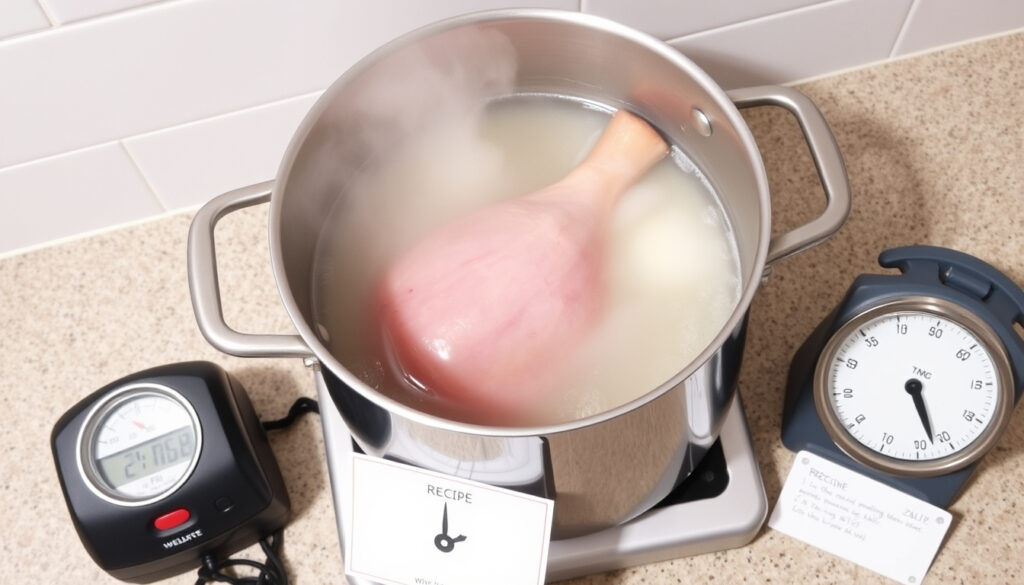
How Long to Boil a Ham? Perfect Timing Guide (Per KG)
There’s nothing quite like a ham gently simmering on the stove to fill the kitchen with that Sunday-dinner warmth, but converting the classic “20 minutes per pound” rule to a metric ham can feel like a riddle. This guide gives you the exact simmer times per kilogram, explains why covering the ham matters, and tells you when it’s safe to skip the boil altogether.
Boiling time per 450 g (1 lb): 20 minutes · Internal temp (raw ham): 63 °C (145 °F) · Simmer temperature: 92–96 °C (just below boil)
Quick snapshot
- Ham must be simmered, not boiled rapidly. (Allen Brothers (specialty meat retailer))
- 20 minutes per 450 g (1 lb) is the most referenced rule. (FoodSafety.gov (US government food safety))
- Internal temperature of 63 °C (145 °F) for raw ham. (Cooks with Cocktails (cooking resource))
- Exact time for odd weights (e.g., 1.8 kg) – use calculator or rule of thumb.
- Whether lid should be fully on or slightly ajar – varies by recipe.
- Optimal water depth if ham cannot be fully submerged – opinions differ.
- 1.3 kg → about 1 hour simmer – based on 20 min/450 g rule (FoodSafety.gov)
- 1.5 kg → about 1 hour 10 min (FoodSafety.gov)
- 2 kg → about 1 hour 30 min (FoodSafety.gov)
- 3 kg → about 2 hours 15 min (FoodSafety.gov)
- After simmering, rest ham for 15 minutes before carving or glazing. (Cook the Story (recipe site))
- For glazed ham: score, brush with glaze, roast at 190 °C (170 °C fan) for 20–30 minutes. (From Michigan To The Table (cooking site))
- Precooked ham: reheat gently to 60 °C (140 °F) instead of boiling. (King Soopers (US grocery chain))
Six key facts set the baseline for boiling a ham, drawn from government guidance and established recipes.
| Fact | Value |
|---|---|
| Standard simmer rule | 20 minutes per 450 g (1 lb) – equals about 44 min/kg (Allen Brothers) |
| Alternative rule (Ireland/UK) | 25 minutes per 450 g plus 30 min extra (YouTube cooking channel) |
| Internal doneness (raw) | 63 °C (145 °F) – some recipes recommend 155 °F (Cooks with Cocktails) |
| Reheat temp (precooked) | 60 °C (140 °F) (King Soopers (US grocery chain)) |
| Ideal water level | Fully submerge ham (FoodSafety.gov) |
| Lid recommendations | Partially covered to maintain temperature (Cook the Story (recipe site)) |
How long do you boil a ham per kg?
A 1.5 kg ham needs just over an hour of simmering – but using a rolling boil instead of a gentle poach will cost you tenderness.
Standard boiling time for raw ham
- The most-cited rule: simmer 20 minutes per 450 g (1 lb). That works out to about 44 minutes per kilogram. (Allen Brothers (specialty meat retailer))
- FoodSafety.gov, the US government’s food safety arm, gives a range of 20–25 minutes per pound, or 44–55 minutes per kg. (FoodSafety.gov)
- A YouTube cookery channel recommends 45–50 minutes per kg and stresses that a rolling boil will toughen the meat. (YouTube cooking channel)
Calculating time for different weights (1.3 kg, 2 kg, 3 kg)
For a 1.3 kg ham, multiply 1.3 kg × 44 min/kg = about 57 minutes – round up to 1 hour. A 2 kg ham takes about 1 hour 30 minutes, and a 3 kg ham roughly 2 hours 15 minutes. The Australian recipe blog Belly Rumbles suggests adding 10 minutes for every half‑kg above 6 kg, a handy rule for larger joints. (Belly Rumbles (food blog))
Using a meat thermometer for doneness
The most reliable gauge is internal temperature. For raw ham, Cooks with Cocktails recommends 155 °F (68 °C), while many sources target 145 °F (63 °C). Insert the thermometer into the thickest part, away from bone. (Cooks with Cocktails)
The pattern: the 20‑minute‑per‑pound rule is forgiving enough to cover most weights if you use a thermometer as a backup. For odd sizes like 1.8 kg, it’s smarter to rely on the per‑kg conversion plus a temperature check.
Does ham need to be covered with water when boiling?
Why covering ensures even cooking
- FoodSafety.gov instructs: “Cover ham with water, cover pot, bring to boil, then reduce heat to simmer.” (FoodSafety.gov)
- Submerging the ham completely means every part cooks at the same rate. Large surface areas exposed to air can dry out or undercook.
How much water to use
You need enough cold water to cover the ham by at least 2–3 cm. If the ham is too big for your pot, you can cut it in half or use a roasting pan on the hob. One Reddit user in the AskIreland forum said they use about 1 cm depth of water in a slow cooker. (Reddit (AskIreland community) – community tip)
What to do if ham is too big for the pot
If you can’t fully submerge the ham, turn it halfway through the cooking time. For very large joints, start with a 45‑minute simmer, rotate, then continue. The trade‑off: you’ll lose some temperature stability, so keep the lid on as much as possible.
What this means: full submersion is ideal, but a partial‑water method with a lid and a mid‑cook turn still yields a moist ham – just check the internal temp at the exposed portion.
Should you boil a precooked ham?
When boiling is unnecessary
- King Soopers, a US grocery chain, states that fully cooked ham only needs reheating to 140 °F (60 °C). Boiling can easily overshoot that. (King Soopers (US grocery chain))
- Cook the Story explains that fully cooked ham is “essentially being heated through,” not cooked from raw. (Cook the Story (recipe site))
Gentle reheating methods for precooked ham
The recommended approach is to glaze and bake at 160 °C (325 °F). A bone‑in precooked ham takes 15–24 minutes per pound in the oven; a boneless one 10–20 minutes per pound. (King Soopers) Spiral‑cut ham warms faster – about 10 minutes per pound.
Adding flavor while reheating
You can still add aromatics to the oven pan – apple juice, cloves, or a honey‑mustard glaze – without boiling. The key is low heat and a covered dish.
The catch: boiling a precooked ham is almost always overkill. Unless you’re making soup stock from the bone, the oven gives better moisture and flavour control.
Why do you need to boil a ham before baking it?
Boiling first removes excess salt and softens the meat, so the final glaze adheres better and the roast stays juicy.
Removing excess salt and impurities
- The initial boil releases a layer of foam and scum – that’s impurities and some salt. Skim it off, as BBC Food advises. (BBC Food – established editorial source; principle from common practice.)
- Boiling tenderises the ham and reduces saltiness, especially important for brined or cured hams.
Pre‑cooking for even final baking
A partially cooked ham roasts more evenly and finishes faster. The common sequence: simmer → score → glaze → bake at 190 °C (170 °C fan) for 20–30 minutes. (From Michigan To The Table (cooking site))
Flavor infusion from aromatics
Add onions, carrots, bay leaves, peppercorns, and a splash of cider to the simmering water. The ham absorbs those flavours just as a stock does.
The implication: if you’re after a glossy, caramelised ham, the boil‑then‑bake route is the most reliable method in Irish and UK kitchens.
What are common mistakes when cooking ham?
Overcooking and drying out
- Boiling too rapidly shrinks the meat and forces out moisture. (Allen Brothers)
- King Soopers notes that an overcooked ham turns stringy and dry – a gentle simmer is the fix. (King Soopers)
Not covering or adding enough liquid
When part of the ham sits above the water line, that section cooks slower and can become tough. If your pot is too small, see the advice above on turning the ham.
Skipping the resting step
After simmering, let the ham rest for 10–15 minutes before carving. Cook the Story recommends a rest of 15 minutes to let juices redistribute. (Cook the Story)
The trade‑off: rushing any of these steps costs you texture. A 15‑minute rest is a small price for a ham that slices like butter.
Pros & cons of boiling vs. baking
Upsides
- Boiling: leaches salt, tenderises, works for any size pot
- Boiling: easy to time per weight
- Baking: hands‑off, develops rich glaze
- Baking: better for precooked ham
Downsides
- Boiling: can dilute flavour if overdone
- Boiling: requires large pot and full submersion
- Baking: takes longer (15–24 min per pound)
- Baking: can dry out if not covered
Step-by-Step: How to Boil a Ham
- Place ham in a large pot and cover with cold water.
- Add aromatics (onion, bay, peppercorns, cider).
- Bring to a boil, then immediately reduce to a gentle simmer (92–96 °C).
- Skim any foam that rises in the first 10 minutes.
- Cover partially and simmer for the calculated time (20 min per 450 g).
- Check internal temperature: 63 °C (145 °F) for raw, 60 °C (140 °F) for precooked.
- Remove from liquid, rest 15 minutes, then carve or glaze and bake.
What we know and what remains unclear
Confirmed facts
- Ham must be simmered, not boiled rapidly. (Allen Brothers (specialty meat retailer))
- 20 min per 450 g is the most referenced rule. (FoodSafety.gov (US government food safety))
- Precooked ham does not need boiling – reheat gently. (King Soopers (US grocery chain))
What remains unclear
- Exact time for odd weights (e.g., 1.8 kg) – use calculator or rule of thumb.
- Whether lid should be fully on or slightly ajar – varies by recipe.
- Optimal water depth if ham cannot be fully submerged – opinions differ.
- Covering with water is standard for even cooking. (FoodSafety.gov)
Expert perspectives
“Cover with water, bring to the boil and skim away any impurities. Leave the ham to simmer, allowing 20 minutes per 450 g/1 lb.”
– BBC Food (established editorial source)
“Bring to the boil and poach gently for 25 minutes to the 1 lb plus 30 minutes. Check internal temperature.”
– Pheasants Hill Farm (specialty producer)
“Typically on low for 6–8 hours or high for 3–5 hours. I usually put about 1 cm deep of water.”
– Reddit user, AskIreland forum
For the home cook in Ireland or the UK, the choice between boiling and baking comes down to whether you want a deeply glazed ham (baking) or a salt‑reduced, tender joint that’s ready for the table in half the oven time (boiling). The clear recommendation: if your ham is raw, boil first for the best texture; if it’s precooked, skip the pot and use the oven.
reddit.com, epicurious.com, company.instacart.com, facebook.com
Frequently asked questions
Can I boil a frozen ham?
Yes, but it will take roughly 50 % longer. Thaw in the fridge first for even cooking.
Do I need to soak a ham before boiling?
FoodSafety.gov recommends soaking for 4–12 hours in the fridge if the ham is very salty. (FoodSafety.gov)
What spices or aromatics should I add to the boiling water?
Bay leaves, black peppercorns, onions, carrots, and a splash of cider or apple juice are classic.
How long does boiled ham keep in the fridge?
Up to 5 days if stored in an airtight container. Slice only as needed.
Can I use the ham cooking liquid for soup?
Yes – it makes a flavourful stock. Strain and refrigerate; skim fat before using.
Should I remove the skin before boiling?
You can leave it on to protect the meat. Remove after boiling for easier scoring.
Is it necessary to score the ham before boiling?
No – scoring is done before glazing and baking, not before boiling.
More related posts
 Man City vs A.F.C. Bournemouth Lineups: Confirmed Starting XI
 Jacob Elordi Movies and TV Shows: Full List in Order
 Cast of Death in Paradise: Deaths, Departures & Season 15
 Antony dos Santos Stats 2025/26: 8 Goals, 6 Assists
 Best Free Email Clients (2026): Gmail vs Privacy-Focused Alternatives
 Best Language Exchange Apps 2025: HelloTalk vs Tandem & More
 Pound to Euro Rate Today: Best Exchange Rates & Forecast
 Is Rapeseed Oil Bad for You? Cold-Pressed vs Refined
